

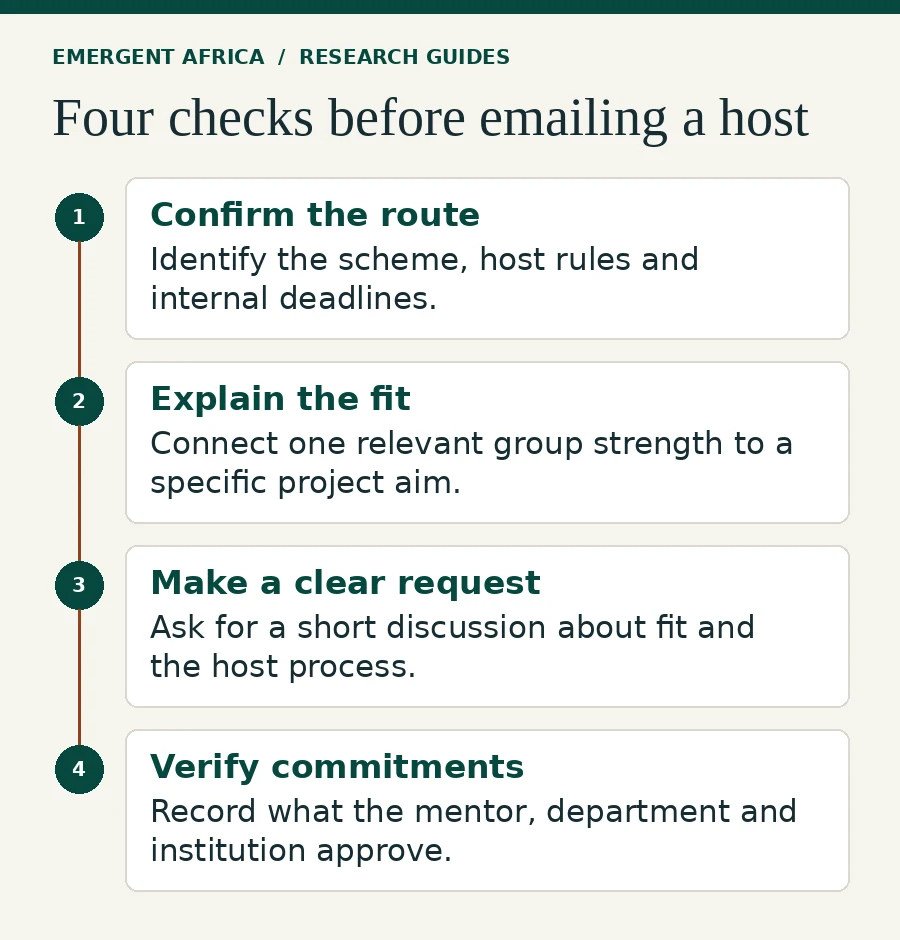
A postdoctoral fellowship host email should name the funding scheme, explain your proposed research in a few sentences and show why the host group fits. Ask whether the researcher would discuss the project and the institution’s approval process. Send a focused CV or one-page outline if the department welcomes attachments.
Your first email starts a conversation about a specific proposal. You are asking a researcher to consider mentoring or collaborating and an institution to consider a possible host commitment. An academic can be interested in the idea while the university has a separate selection process, support deadline or limit on nominations. Find those details early.

In this guide
Confirm what the fellowship expects from a host
Read the call and its applicant guide. Record the planned start date, length, proposed host location and requirements for the researcher and institution. Some opportunities ask for a jointly developed proposal. Others require a sponsoring scientist’s statement, an institutional approval or a named mentor who can supervise the training plan. Keep a note of the exact role and the stage at which it is required.
For a Marie Skłodowska-Curie Actions Postdoctoral Fellowship, the European Commission describes an application prepared with a host organisation. Read the work programme and call documents for the applicable experience and mobility rules and the differences between fellowship types. An interesting group cannot resolve an ineligible host or mobility history. Check the MSCA guide to preparing a postdoctoral fellowship application.
Ask whether the host has an expression-of-interest process. The department may invite potential applicants to send a concept note before a central review. The institution may also set an internal deadline for costing, approvals or nomination. Oxford, for example, directs external researchers seeking an award host to the relevant department, faculty or academic division. See Oxford’s research funding guidance.
Choose a host you can explain in two sentences
Start with the project question. Identify a method, collection, partner relationship or research community that the project needs. Find a group with current evidence of that strength. Read a recent output and confirm the proposed mentor’s role. Use a publication, programme or facility page to make your fit sentence specific.
For example, if you plan to compare public climate records across cities, choose a group with demonstrated work in data harmonisation. Explain which part of that work could help the first aim, such as the method for documenting incompatible location identifiers. Show what you bring to the group, perhaps expertise in public datasets or a pilot codebook you can share. The two directions make the collaboration easier to assess.
Be precise about access. A publication showing that a lab used a dataset gives you a reason to ask about it. Permission to use the data in a new project requires confirmation. Treat equipment, computing, workspace, software licences, staff time and partner access as questions until the responsible people agree.
| Question | Check before you email | What to say in the email |
|---|---|---|
| Does the host fit the scheme? | Eligible country, institution, mentor role and internal route. | Name the scheme and ask for the department’s process. |
| Does the group fit the project? | Recent work, method, resources or collaboration. | Connect one verified strength to one specific aim. |
| What can you contribute? | A genuine result, skill, publication or transferable method. | Give one clear example of your contribution. |
| What does the host need to do? | Mentoring, approvals, proposal input and possible facilities. | Ask for a short meeting and specify the immediate decision. |
| Can the timeline work? | Call deadline, institutional cut-off and review time. | State the funder date and ask about earlier host dates. |
A postdoctoral fellowship host email template
Subject: [Fellowship name] host enquiry for [short project theme]
Dear Dr [surname],
I am [name], a [current position or doctoral status] at [institution]. I am preparing an application for [scheme and call] and would like to ask whether you would consider discussing the project as a potential host mentor.
My proposed project asks [one research question]. I plan to [main approach] and produce [specific result or output]. In my doctoral or current work, I [relevant contribution and evidence]. Your group’s work on [specific publication, method or programme] is relevant because [link to one aim or training need]. I would bring [specific expertise, experience or resource] to the collaboration.
The funder’s deadline is [date and time zone]. Could we arrange a brief call to discuss fit and the department’s process for considering hosts? I can send a one-page outline and CV if useful. I would also appreciate any guidance on internal deadlines.
Best wishes,
[Name]
[Current role and institution]
[Public research profile, if relevant]
Keep the first request small. A brief call or invitation to send an outline is easier to answer than a request to commit to a full application. If the institution asks applicants to submit a form first, use that route and adapt the email to its instructions. Avoid sending the same note to many people in one group without checking its policy.
A worked email with a specific research fit
Illustrative email: the people, institution and research group details are fictional. Replace the named work with a verified publication or resource from your chosen host.
Subject: Postdoctoral fellowship host enquiry on neighbourhood heat records
Dear Dr Mensah,
I am Nia Okoro, a doctoral researcher in urban geography at Example University. I am planning a postdoctoral fellowship proposal about the comparability of public heat records and would like to ask whether you would consider a short discussion about hosting it.
My project would test how differences in location identifiers and observation dates affect comparisons across three cities. In my doctoral work, I built a reproducible workflow for matching public temperature records and documented the cases it could not resolve. Your group’s published work on documenting uncertainty in municipal datasets is relevant to the project’s first aim. I would like to develop the comparison with your team and share the extraction and quality-checking materials for future projects.
I am checking the scheme’s host requirements and the institutional timetable. Could we speak for 20 minutes in the next two weeks about the research fit and whether your department accepts expressions of interest? I have attached a one-page outline and a two-page CV, as suggested on the department’s fellowship page. I would be happy to use the department’s form if that is the next step.
Best wishes,
Nia Okoro
The example gives the reader an aim, a genuine basis for collaboration and a next action. Its fit sentence should name the actual work in a real email. It avoids assuming that the academic can approve access or make an institutional commitment. If you already know the external deadline, include it. If the next call has yet to publish dates, give the expected planning period and say when you will check again.
Prepare a one-page project outline
Write the outline for a specialist who has limited time. Start with the problem and the proposed contribution. State two or three aims, the approach and the main output. Then show what you would learn at the host institution and which facilities, permissions or staff input would need to be confirmed. Use an indicative schedule that includes the start-up and approval work.
Put the scheme name, proposed dates and your contact details on the first page. Include a short section on host fit. Identify decisions the academic can make and those the department or grants office handles. For example, the mentor could discuss research alignment and supervision frequency. The institution may confirm infrastructure access, costs and the authorised applicant or signatory.
Use a CV that highlights work relevant to the proposed fellowship. Include the correct status of manuscripts, outputs or research roles. If the programme requests a particular CV format, follow it for the formal application. The initial email can point to a public profile when attachments are discouraged. Keep unpublished or sensitive materials for an agreed discussion and the appropriate institutional channel.
Check the route in the destination country
The scheme governs the process. In the UK, a department may run an internal selection round before deciding whose application it will support. In Europe, EURAXESS publishes some host opportunities and guidance for MSCA applicants. Verify the current call and the listing’s own deadlines. Use the EURAXESS guidance on finding an MSCA host.
In the US, some sponsor-led schemes require a written statement from the scientist and a description of the research environment. The NSF Postdoctoral Research Fellowships in Biology solicitation is one example of a programme with specific sponsoring scientist requirements. Use the relevant solicitation for your discipline and eligibility. See the NSF programme instructions.
In Canada, confirm which agency’s mandate fits your research and whether the proposed institution can hold the award. A host email should identify the funding route, your status and the intended training or research relationship. Read the Canada Postdoctoral Research Award programme guidance and the selected agency’s current instructions.
Handle replies and formal commitments
If the academic is interested, ask which person or office coordinates the expression of interest. Confirm the proposal review timetable, expectations of the mentor, access needs and which commitments must be documented. Ask whether the host office provides a template. Send a short recap after the call so both sides can correct misunderstandings while the plan is still flexible.
If you receive no reply, check the institution’s recommended route and send one brief follow-up after a reasonable interval. Refer to the original email and restate the question. If the deadline is close, contact the published fellowship coordinator for process guidance. Give yourself time to consider another host if the group cannot support the application.
Record the funding and employment terms when the scheme and institution can confirm them. Check what the award pays, what the host supplies and what your own status would be. The questions in the funded PhD offer checklist can help you separate fees, cash, dates and conditions, although the legal and institutional terms of a postdoctoral award may differ.
Bring three decisions to the first meeting. Ask whether the project is a fit, whether the researcher has time to supervise it and whether the department can consider the application before its deadline. If the response is positive, agree on the next evidence to share. For example, you might revise one aim after a methods discussion and ask the grants office to confirm the resources needed for that aim. Put a date next to each action. This keeps a promising conversation moving while leaving the institution time to decide whether it can support the full proposal.
Frequently asked questions
Should I write before I have a complete proposal?
Yes, if you have a clear idea, can identify the scheme and have checked the host’s instructions. A concise concept note gives the prospective mentor enough information to comment. Some institutions request a full outline or a form. Prepare what the host needs for its first review.
How long should the first host email be?
Aim for a message the recipient can read quickly. Three short paragraphs can establish who you are, explain fit and ask for a decision about the next conversation. Put more detail in a permitted outline rather than listing every proposed work package in the email.
Can two institutions host the same proposal?
Check the rules for the exact scheme and role. Some calls allow multiple organisations under defined arrangements. Others require a single lead host or restrict parallel submissions. Discuss each organisation’s responsibilities and obtain the necessary approval before naming it in the proposal.
What if the host asks for a project budget?
Ask which costs are set by the scheme and which need local costing. Write a short work plan and map each resource to a task. Use the small research grant proposal template for an example of this reasoning, then use the host office’s rates and the fellowship’s budget rules.
Explore more doctoral and postdoctoral funding guides. Researchers who want professional recognition can review Emergent Africa’s fellowship criteria, which use a separate assessment process from research funding programmes.