

A small research grant proposal explains a specific gap, what you can learn within the award period, and how each cost supports that work. Use the template below to draft a pilot application, then map each section to the funder’s form. The worked example shows how a £1,440 request can support a defined feasibility decision.
Small grants are especially useful when one practical uncertainty blocks a larger project. Perhaps you need to check whether records exist in a usable format, whether a partner can provide access, or whether a coding procedure can be repeated reliably. Start with that uncertainty. A reviewer should understand what the award buys and what evidence will exist when the money is spent.

In this guide
Check the scheme before drafting the proposal
Read the opportunity notice, guidance and application form together. Record the eligible applicant, host organisation, project dates, award ceiling and any restrictions on spending. Write down the institution’s submission deadline as well as the funder’s deadline. An internal approval process can close before the portal does.
Find the assessment criteria and copy their headings into your working document. If the scheme assesses relevance, feasibility and use of resources, make those points easy to locate. A paragraph that makes sense as background may have little value in a field asking how you will deliver the work. Check the research grant eligibility checklist before you invest time in the narrative.
Check which costs the scheme actually pays. A university small grant might cover temporary assistance and local travel. Another call might exclude salaries, equipment or dissemination costs. Ask the finance team about overheads, payroll rates and taxes where relevant. Keep a record of what they confirm so that the narrative and budget use the same figures.
A small research grant proposal template
Use this as a planning worksheet. Give each answer one clear job before expanding it to the application limit. Put the most decision-relevant fact in the first sentence of each answer.
| Proposal section | What to write | Check before you submit |
|---|---|---|
| Title and summary | Name the subject, the activity and the intended output. | A reader outside the field can describe the pilot. |
| Problem and gap | Explain what is known, the remaining uncertainty and why it matters. | Cite a relevant source for the background claim. |
| Aim and objectives | State one feasibility aim and two or three observable tasks. | Each objective has a measurable output or decision. |
| Methods and access | Explain the records, selection, procedure, analysis and permissions. | The host can provide the resources you name. |
| Timeline and risks | Link work to weeks, dependencies and a decision point. | The schedule allows for review, delays and reporting. |
| Budget and justification | Show quantities, rates and the activity that needs each item. | The total reconciles with the finance form. |
| Outputs and next use | Identify what you will deliver and who can use it. | The outcome is within your control and the grant period. |
Start the summary with the gap and proposed action. A useful structure is: “We cannot yet determine whether [uncertainty]. Over [duration], we will [activity] using [material or data]. We will assess [criteria], deliver [outputs] and use the results to decide [next step].” Replace each bracket with a fact specific to your project. Avoid repeating the whole background in the short summary.
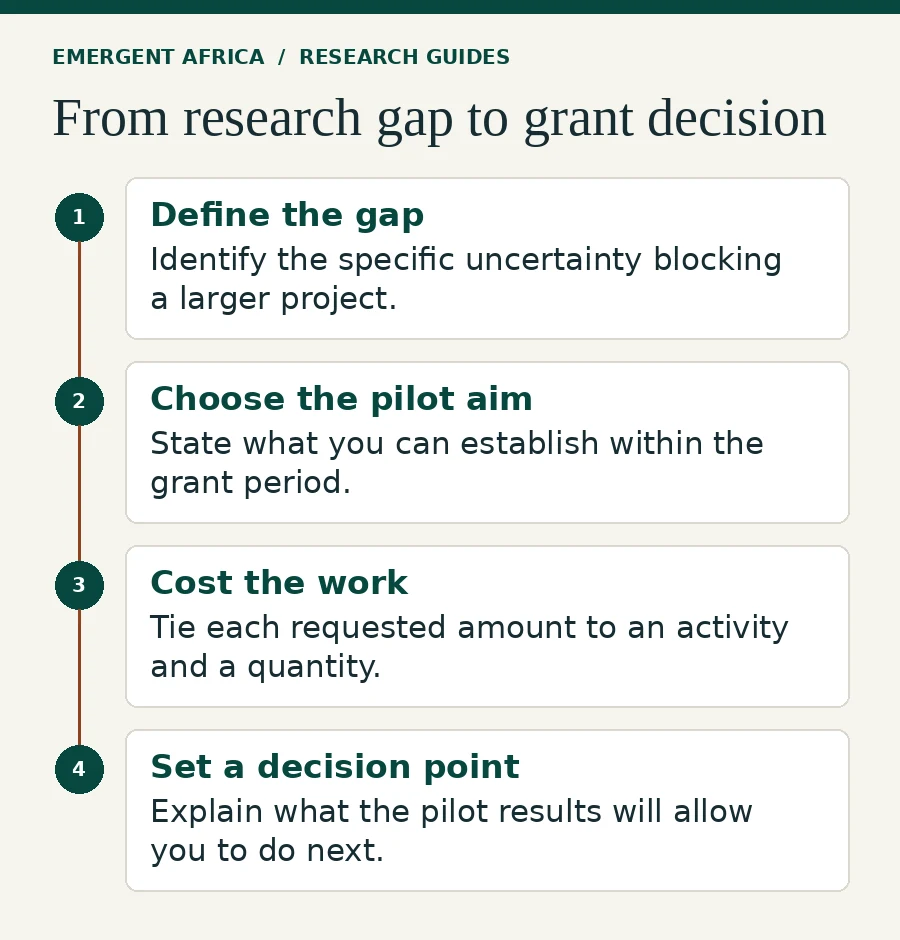
Worked proposal for a public data pilot
Illustrative project: testing whether public temperature and shade records can support a larger study of outdoor heat exposure. The locations, quantities and costs are examples.
Project title: Testing the completeness of public heat and shade records for a neighbourhood study.
Summary: A team planning a larger outdoor heat study needs to know whether municipal temperature and shade records can be matched at street level. Over twelve weeks, the team will test a documented extraction procedure across 30 locations. It will record which locations have usable paired records, check agreement between two reviewers on a small subset and produce a data dictionary and coverage report. The findings will determine whether to expand the approach, revise the selection rules or seek another data source.
Gap and significance: Public sources can contain measurements and maps at different dates or levels of detail. A location name alone does not establish that the records describe the same place and period. If enough locations can be matched using transparent rules, a larger study can plan its coverage and analysis with fewer unknowns. If many records fail the checks, the pilot will reveal where new collection or partner access would be needed.
Aim: Assess whether a reproducible extraction method yields sufficiently complete and comparable records for a larger neighbourhood study. Define “usable” before looking at the outcome. In this example a usable location has a matching location identifier, a temperature record in the study period, a shade measure and documented provenance. The team can specify additional requirements if its research question needs them.
Objectives: First, prepare an extraction guide and test it on five locations. Second, record completeness and reasons for missing or mismatched fields across all 30 locations. Third, have a second reviewer independently assess ten records and resolve disagreements in a decision log. The 30 locations represent a practical range of record availability for this pilot. They are an illustrative workload, with no claim to represent the city.
Methods: Select locations across three neighbourhoods using criteria documented before extraction. Record the source, retrieval date, unit and geographic identifier. Save a record of changes to the extraction rules and recheck affected entries when a rule changes. Summarise completion counts and disagreements. If licensing prevents sharing the records, share a blank dictionary and a source inventory within the permitted terms.
Decision: In the example, at least 24 of the 30 locations must have usable paired records, with at least eight usable locations in each neighbourhood. At least eight of the ten independently checked records must receive the same initial completeness classification. These numbers are planning choices. The team would justify them against the minimum coverage it needs in the larger study and assess how a small change in the threshold affects the decision.
Outputs: The team will deliver the extraction guide, a coverage summary, a list of unresolved data problems and a short recommendation. The recommendation might be to proceed with the current sources, improve location matching and repeat a small check, or replace a data source. It will identify the budget and access implications of each path. A subsequent paper or funding application depends on later work and should be described as a possible use.
Build a budget the reviewer can follow
Ask what happens to each line item if the corresponding activity is removed. If nothing changes, the justification needs more work. Also check whether an existing institutional resource covers part of the activity. Describing verified access to software or staff time makes the plan easier to assess and reduces double counting.
| Illustrative cost | Basis | Request | Activity supported |
|---|---|---|---|
| Temporary project assistance | 24 hours × £40 | £960 | Extract, document and check records under supervision. |
| Local site checks | 8 return journeys × £30 | £240 | Check the location identifiers where map labels conflict. |
| Permitted data access | 2 approved datasets × £80 | £160 | Obtain specified reference files for the matching exercise. |
| Output accessibility review | 2 hours × £40 | £80 | Check the clarity and accessibility of the public summary. |
| Total requested | £1,440 |
The example assumes the four lines are eligible and the rates include the costs the institution must charge. Check both assumptions for your application. If a reference dataset is already covered by an institutional licence, remove the purchase and record the existing access. If the call excludes travel, explain whether remote checks can provide adequate evidence or whether another approved source will pay for visits.
Write a short justification beside the calculation. For the assistance line, explain how the 24 hours were estimated. For example, the team could allow 12 hours for first extraction, six for documentation, four for a second review and two for resolving discrepancies. The split should reflect the real staffing plan. Give enough detail to show why the request is proportionate. See the budget justification worked example for a method you can adapt to other cost lines.
Make the delivery plan credible
Set the project period from the date the scheme allows spending. In weeks one and two of the example, confirm permissions and test the recording guide. Complete extraction by week six. Check classifications and coverage by week nine. Use the remaining weeks for the decision, handover and report. Reserve some time for the final review before the submission date. The pilot study grant timeline example shows what these milestones look like in a table.
Give each main risk a trigger and a response. For example, if one neighbourhood has fewer than eight usable records after the first extraction round, the team will trace which fields are missing. If the cause is a consistently absent shade measure, it will assess a documented alternative source against the same rules. If the problem is an ambiguous location match, it will test a revised matching rule and log which entries changed.
Show how the plan will still produce a useful output if the original approach fails. A credible coverage report can document why the team should change its design. Promise to record the reasons for the decision and say who will review them. A pilot can serve its purpose even when the results rule out the first option.
Adapt the draft to the funder’s questions
UKRI’s Funding Service guidance distinguishes the proposed vision, approach, ability to deliver and resources. Use the wording of the actual opportunity to decide how to group your material. For a US NIH application, read the notice and application instructions to see whether it uses a Specific Aims attachment, a Research Strategy or a different structure. A planning template will help you write the answers in the correct format.
For Canadian CIHR proposals, read the programme’s application and review guidance together. Make the proposed contribution and the methods clear in terms that fit the particular competition. For European calls, use the official call and submission instructions to confirm the participant role, budget rules and required attachments. A university internal grant may need a shorter account of the same problem, method and output.
Use the UKRI core application guidance, NIH advice on application sections and CIHR adjudication criteria as examples of how funders frame assessment. Consult the exact competition documents for your submission.
Review the proposal like an assessor
Ask a colleague to read just the summary and explain the aim in one sentence. If the answer describes the larger research ambition but misses the pilot decision, revise the summary. Then ask the colleague to trace a budget line to a method and a milestone. This short exercise exposes missing quantities, inaccessible sources and activities with no budget.
Read the application in the portal before submission. Confirm that tables and symbols render, the dates match the budget, and every required attachment opens. Ask the responsible office to verify any commitment it must make. Keep the submitted version, the approved budget and the confirmation receipt together so the team can refer to the same record after a decision.
Frequently asked questions
How long should a small research grant proposal be?
Use the funder’s stated word, character or page limit. In an internal draft, assign space according to the review criteria and the complexity of the proposed work. An assessor should be able to find the gap, method, costs and intended decision without reading background that is unrelated to the pilot.
How many objectives should a pilot proposal have?
Two or three clear objectives can work well for a modest pilot when they cover preparation, collection and interpretation. Use as many as the work needs and each must be achievable within the award period. Give every objective a deliverable or a criterion the team can check.
Can a proposal include a budget reserve?
Check the specific cost rules and ask your finance contact how the scheme handles uncertain prices. Where a reserve is excluded, build the budget from supported quantities and current rates and describe how you will handle cost changes. Identify which work can be rescheduled or revised if an estimate increases.
Can I reuse the example in a different discipline?
Keep the relationship between uncertainty, method, budget and decision. Replace the project details and thresholds with evidence and assumptions that fit your own research. A pilot involving participants, restricted records or fieldwork will have different approvals, timescales and costs.
Browse research grant application guides for eligibility, budgets and timelines. Researchers building a record of professional contribution can also review the Emergent Africa fellowship criteria. Fellowship assessment and research grant applications follow separate processes.