

Before accepting a funded PhD offer, check the international tuition charge, what the funding pays, how much cash you will receive and for how long. Compare the admission letter with the award letter, assistantship appointment or employment contract. Ask for written clarification on uncovered fees, payment dates, duties, renewal conditions and support during any unfunded months.
The phrase “fully funded” is a starting point for questions. A useful comparison turns each offer into a set of confirmed amounts, dates and conditions. A high stipend can leave less for living costs when part of it must pay tuition or compulsory charges. A lower annual amount may be easier to plan around when the fee coverage and payment schedule are clear.

In this guide
Collect the written offer documents
Start with the admission letter, fee assessment and funding letter. Check whether they refer to the same programme, start date and period. Look for a separate appointment if teaching or research employment is part of the package. If you have an external award, find out how it interacts with the university’s support and who pays each part.
The relevant terms may be spread across documents. A university can make admission conditional on degree completion. A department may provide a stipend subject to satisfactory progress. A contract may set work hours, pay dates and employment conditions. Record the person or office that can confirm each item.
When two documents appear to conflict, quote the relevant lines in a short email and ask for the applicable terms. For example, one letter might say “tuition support” and another list the international tuition rate. Ask whether the stated support covers the full amount you have been assessed for or a specific contribution. Keep the response with the offer.
Funded PhD offer checklist for international students
| Check | Ask for this in writing | What to compare |
|---|---|---|
| Tuition and fee status | International tuition rate, amount covered and any waiver conditions. | The fee gap for each year of study. |
| Stipend, fellowship or salary | Amount, currency, payment frequency and first payment date. | Cash available by month and year. |
| Mandatory charges | Compulsory student fees and health plan charges, with coverage amounts. | Charges that will come from your own funds. |
| Guaranteed period | Start date, end date, summer provision and renewal conditions. | Funded months versus expected completion time. |
| Duties | Teaching or research hours, assignment process and separate pay if applicable. | Workload and the effect on research time. |
| Research costs | Access to equipment, data, fieldwork and conference funds. | Whether the project can proceed with the available resources. |
| Leave, delays and changes | Process for leave, extensions, changes of supervisor and funding interruptions. | Which conditions would affect the award or contract. |
| Arrival and acceptance | Decision deadline, required documents and likely first costs. | The cash and time needed before the first payment. |
Put uncertain items in a separate column. Treat confirmed funding, likely funding and pending applications as different figures. A possible external award or renewal is useful information. Keep your base comparison tied to the support the institution has committed to in writing.
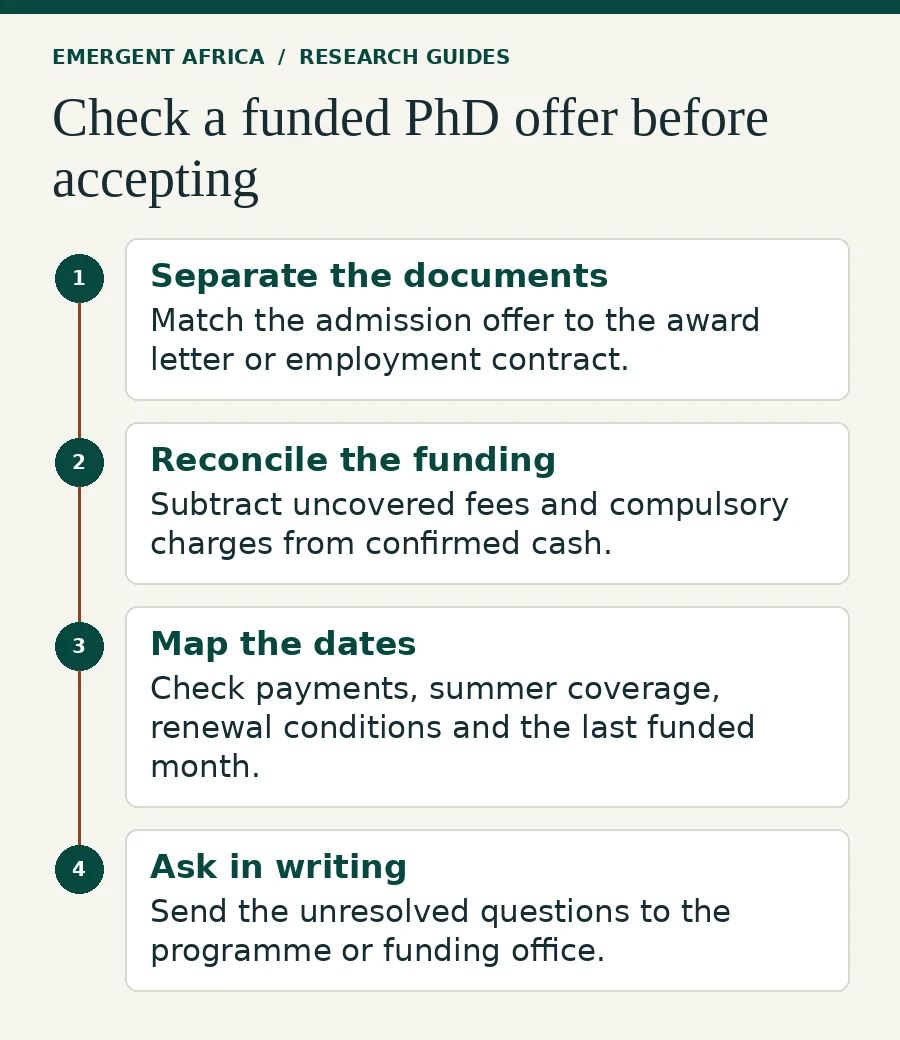
Compare actual cash after uncovered charges
Use the same time period for each offer. First calculate the fee gap by subtracting confirmed tuition coverage from the tuition charge. Then subtract that gap and compulsory uncovered charges from cash support. Keep housing, food, transport and relocation costs in a separate monthly budget. For an employment contract, ask the university about estimated deductions and compare the actual payment schedule.
Worked example with two fictional UK offers
| Annual amount | Offer A | Offer B |
|---|---|---|
| Confirmed cash stipend | £21,500 | £19,500 |
| International tuition charge | £22,000 | £21,000 |
| Confirmed tuition coverage | £17,000 | £21,000 |
| Uncovered tuition | £5,000 | £0 |
| Other compulsory charges paid by student | £300 | £300 |
| Cash after those charges, before living costs | £16,200 | £19,200 |
Offer B leaves £3,000 more for living costs in this example. Offer A starts with a stipend £2,000 higher but has a £5,000 fee gap. The calculation does not decide which programme is the better fit. It tells you what the funding terms mean for the year compared. Research alignment, location, duties and how long the support lasts also matter.
The annual result can hide a timing issue. If a £5,000 fee balance is due at registration and the first stipend arrives at the end of the month, you may need cash before the award pays anything. Ask about billing and whether the tuition contribution is applied to the account before payment is due. A monthly calendar can reveal the arrival costs that an annual spreadsheet misses.
Check funding through the expected completion date
Record the number of funded years and months. Compare those dates with the programme’s expected milestones and normal completion period. Ask what support applies during thesis writing, a required placement, the summer or a period between appointments. The funding package may have different sources in different years.
Make a table with one row per year or term. Include the funding source, amount, duration, condition and who confirms it. In one package, the first year may be a fellowship and the later years teaching appointments. Ask whether the later appointment is guaranteed subject to progress, offered competitively or still to be arranged. Confirm who would pay the tuition if an appointment is delayed.
Review the conditions for renewal, leave and extensions. The university may have published rules about progress reviews or funding changes. Ask how those rules apply to your award. If the project is expected to take longer than the support, identify which costs would fall in the unfunded period and what options the institution can confirm.
For example, an offer of £1,800 per month for nine months provides £16,200 over the stated period. Budget for all twelve months when comparing it with a package that pays year-round. If the institution says a separate summer appointment is available, ask whether it is included in the written guarantee and what happens if you are not assigned a role.
Distinguish a scholarship from an employment package
A doctoral offer can combine student funding and paid duties. A salaried research position may have a contract setting gross pay, hours, benefits and leave. A studentship or scholarship may use different terms and payment arrangements. Read the actual award and appointment documents and ask the relevant office which conditions govern each payment.
For a teaching or research assistantship, clarify the duties and time commitment. Ask how the department assigns work, whether the appointment continues during holidays, and how the work relates to your thesis. The offer should identify what is expected and who supervises it. See the graduate assistantship offer checklist for questions about fees, duties and renewal.
Ask what happens if you receive another award. A programme might replace part of the institutional package, allow an additional amount or require approval. Record the rule before adding two awards together in the budget. Compare the guaranteed package under each scenario and keep any pending application outside the base calculation.
Check the rules in the study destination
United Kingdom
Check whether the award covers your actual international fee or contributes at a stated rate. UKRI’s training grant terms allow the difference between home and international fees to be met from other sources. Ask the university whether a separate award or waiver covers it and for how long. See the UKRI training grant terms and support for UKRI-funded students.
United States
Ask which costs the named graduate programme covers and which appointment conditions apply. Cornell Graduate School, for example, describes packages that can include tuition, fees, health insurance and a stipend through fellowships or assistantships. Review the programme’s actual letter for summer coverage and each component. See Cornell Graduate School’s financial support guidance and assistantship descriptions.
Canada
Confirm how the quoted funding relates to tuition and compulsory fees. A university may publish minimum support for eligible students while the department describes the particular funding sources and payment dates. Waterloo explains how its minimum funding works and which students it applies to. Ask the programme for your assessment and a written schedule. See the University of Waterloo minimum funding guidance.
Continental Europe
Identify whether the offer is an employment contract, scholarship or another funding arrangement. Terms can differ across countries and within the same institution. For a salaried Dutch university position, check the appointment and the applicable collective agreement. For a scholarship, check its own terms, any charges and the status it confers. See the Dutch universities’ collective labour agreement.
For any destination, consult the official immigration authority and the university’s international student team for the current documents and process. Ask the institution which funding evidence it can provide and when it issues it. The admissions, employment and immigration decisions each have their own requirements.
Include research expenses and living costs
Ask what the project needs to run. Identify the training, field visits, equipment, software and specialist services in the proposed research. Confirm which items the department provides and whether separate applications are required for research or conference funds. A stipend that covers living costs does not itself show that project costs have been approved.
Build a monthly living budget for the actual location. Use current prices for likely accommodation, utilities, transport and food. Include a separate estimate for relocation, initial deposits and expenses before the first payment. When comparing currencies, record the exchange-rate date and test how a reasonable change would affect the comparison. Keep the original amounts visible.
If family members will move with you, confirm any support, insurance or accommodation conditions that apply to them. Use official sources and written university guidance for costs and eligibility. Build the plan around confirmed arrangements and identify what needs a decision before you accept.
An email to clarify a funded PhD offer
Subject: Clarification of funding terms for [programme and offer reference]
Dear [programme or funding contact],
Thank you for the offer for [programme] starting [date]. Before I respond, could you confirm the international tuition charged for my first year and the amount the award covers? Please also confirm any compulsory charges I would pay and whether the same fee coverage applies in later funded years.
I would appreciate the start and end dates of the guaranteed funding, the payment schedule, and any assistantship duties or conditions for renewal. Could you confirm whether summer months are funded and when the first payment would be made?
My response deadline is [date]. If another office handles any of these points, please let me know the appropriate contact. Thank you for helping me interpret the offer.
Best wishes,
[Name]
Use the questions that remain open after reading the offer. Include its reference and the exact wording you need clarified. Save the answer and compare it with any updated award letter. Ask for any change to be reflected in the written terms before relying on it.
Frequently asked questions
Does a funded PhD cover international tuition?
It depends on the offer. Some packages cover the full assessed fee. Others contribute at a specified rate or require a separate waiver. Ask for the tuition charge, confirmed coverage and balance payable for each funded year.
Is a PhD stipend the same as a salary?
Check the payment and status described in your documents. A scholarship or stipend can have different conditions from an employment contract. Confirm the expected amount you receive, deductions where applicable, duties and benefits with the responsible office.
Can I ask for more time to decide?
Yes. Ask the programme before the deadline and explain the specific information you are waiting for. Keep the original deadline unless the programme confirms an extension. A short written request with your offer reference helps the office respond.
What if I have an offer without a funding letter?
Ask who can provide the funding decision and when it will be issued. Keep the admission conditions and funding evidence separate in your comparison. If the package is pending, plan using the costs and support that have already been confirmed.
Browse doctoral and postdoctoral funding guides for related host and offer checks. Researchers considering professional recognition can review the Emergent Africa fellowship criteria as a separate route from doctoral funding.
If you are already preparing for the next stage after your doctorate, see the postdoctoral fellowship host email template for a way to start that conversation with a prospective institution.