

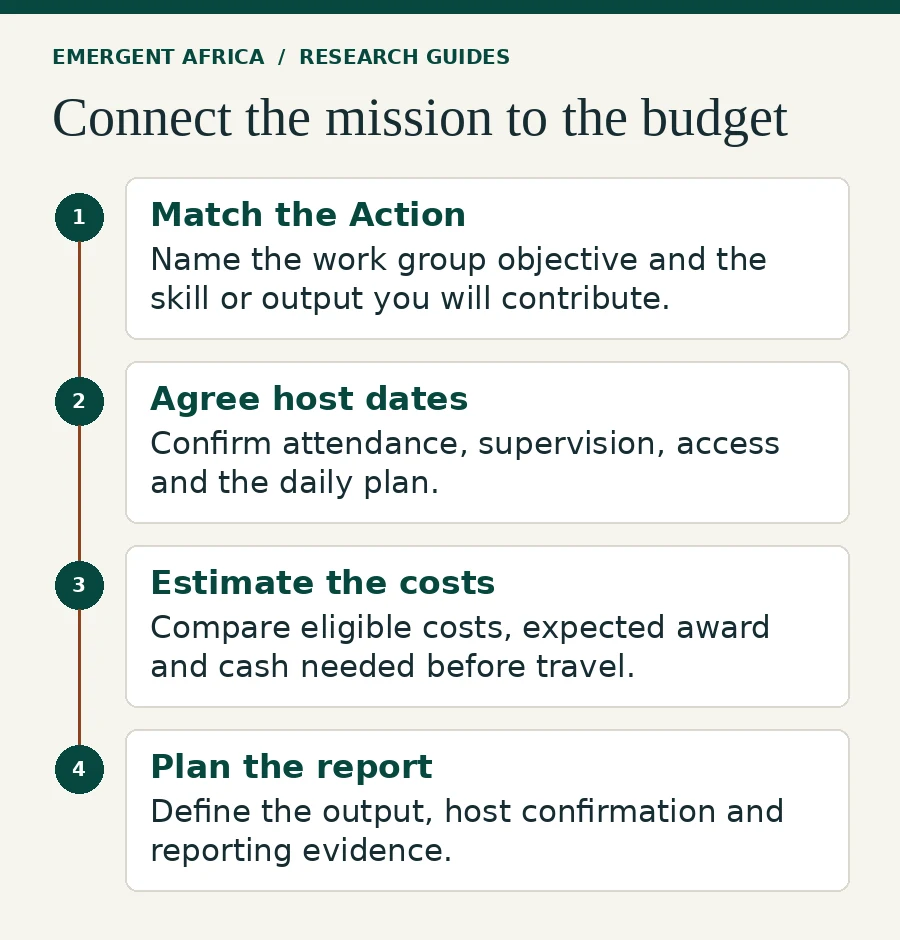
A Short-Term Scientific Mission application budget should show how the visit’s dates, work plan and estimated costs fit the COST Action’s call. Start with the host’s written agreement and the Action objective you will support. Price the eligible journey and stay, check the award limit, and work out how much cash you would need before payment.
An STSM funds a defined visit connected to a COST Action. The proposal needs to explain why working at the host organisation helps the network achieve something specific. A cost table is easier to assess when the reviewer can trace the nights, journey and daily allowances to a plausible schedule.

In this guide
Confirm which COST Action call applies
Read the current Action call alongside the COST Annotated Rules. The rules describe an STSM as a visit for specific work at a host in a country different from the researcher’s or innovator’s country of affiliation. Check the definition of affiliation, the Action’s eligibility requirements and the way your primary affiliation is recorded in e-COST. Your passport, residence and research affiliation can be different facts.
Write down the Action number, the working group or objective, the available grant period and the deadline. Check whether the call gives a ceiling, a method for calculating the award or any restrictions on costs. An Action’s own call can set an available amount below the level a general programme document permits. Use the call applicable to your dates and grant period.
Confirm the documents the Action wants and who approves them. The e-COST guide shows the application workflow, including the requested amount in euros, visit dates and host details. Check the current call for any additional scoring criteria, templates and deadlines. See the COST Annotated Rules and the e-COST grant awarding guide.
Agree the visit with the host
Send the host a short project outline and a date range. Ask which named person will supervise the work, which activities can take place on site and what access will be available. Confirm the location and whether a training session, meeting room, computing account or data permission needs separate approval. A letter that only says “we welcome a visit” leaves the scope and resource commitments unclear.
Explain what you can prepare remotely. A visit proposal becomes more credible when the host days are reserved for work that benefits from collaboration. For example, send a draft checklist and a public dataset inventory before travel. Use the visit for the host’s feedback, shared testing and agreement on a reusable output. Do your own formatting and routine report writing from home.
Check that the host can provide written confirmation in the required form. Dates and city should match the work plan and e-COST fields. Any contribution such as workspace, software access or accommodation should be confirmed by the person who can authorise it. Record pending decisions separately so that they do not appear as secured resources.
A five-day mission work plan example
Illustrative mission: a researcher affiliated with a UK university visits a host group in France to test a shared procedure for recording gaps in public transport datasets. The hypothetical Action working group wants partners to document data quality consistently. The host team has relevant experience and has agreed to review the draft procedure.
| Stage | Work and responsibility | Evidence to keep |
|---|---|---|
| Before travel | Visitor sends a draft checking guide and two small public datasets. Host confirms access and meeting times. | Host agreement, draft guide and permitted source list. |
| Day 1 | Visitor and host agree field definitions, responsibilities and test records. | Agreed checklist and meeting note. |
| Days 2 and 3 | Both apply the guide to a shared sample and record discrepancies independently. | Completed sample logs and a comparison sheet. |
| Day 4 | Team compares disagreements and revises rules for missing or unmatched fields. | Versioned guide and decisions log. |
| Day 5 | Team runs a short repeat check and agrees how the working group will review the output. | Repeat check, action list and handover. |
| After the visit | Visitor submits the report and shares the approved guide with the Action working group. | Report, host confirmation and permitted shared files. |
This plan gives the host a real role in interpreting differences and refining the guide. The deliverable is a reviewed procedure, with a small test and a record of unresolved issues. It does not depend on a journal accepting a paper or on every partner adopting the method. The proposal can state how the working group will be invited to use the guide and who will record its feedback.
Use an agreed access arrangement. Public datasets can still carry reuse conditions. Record the terms and give the host a way to check the sources. If the chosen records become inaccessible, the team can use a permitted alternative already identified in the plan. The work should still answer the mission’s central question.
A short-term scientific mission budget in euros
Assume the visitor arrives on Sunday, works Monday to Friday and returns on Saturday. That means six nights and seven calendar days away. The allowance shown here is a planning estimate. Use the expense categories, allowance basis and eligible dates in your Action’s call.
| Cost | Planning basis | Estimated cost |
|---|---|---|
| Return rail travel | One economy return fare | €210 |
| Accommodation | 6 nights × €82 | €492 |
| Local transport | One pass for the planned journey | €38 |
| Subsistence | 7 days × €45 | €315 |
| Estimated trip cost | €1,055 | |
| Confirmed host contribution | Host purchases the local transport pass | €38 |
| Estimated cost to the visitor | €1,055 less €38 | €1,017 |
| Illustrative amount requested | Assume the call allows a €900 award request | €900 |
| Remaining amount to cover | €1,017 less €900 | €117 |
The example assumes the remaining costs can be included in the calculation and the host contribution is permitted. It uses the call limit to calculate the request. If a scheme offers a fixed contribution or a different allowance, record that rule and calculate the expected shortfall separately. Avoid treating an estimate as an approved award.
Attach price evidence where required. Note the fare class, dates, cancellation terms and quote date. For accommodation, use the full price for the eligible nights and record any local taxes. Keep the currency conversion source and date for costs quoted in pounds or another currency. Follow the Action’s specified exchange-rate procedure if it gives one.
Check the cash needed before travel
Estimated trip cost and cash required before payment are different decisions. If the visitor pays €1,017 and receives €900 after the report is approved, they may need to cover the full €1,017 in advance. A €117 final gap does not establish that the visitor can finance the trip. Ask when the award is paid and whether the institution has an authorised advance or travel booking arrangement.
In the example, the visitor might ask their institution to book the €210 rail ticket directly and confirm how this affects the grant and personal cash requirement. That would reduce the immediate outlay if the arrangements permit it. The institution would still need a clear way to reconcile its booking with any award payment. Record each source of support and who will pay which cost.
Consider price changes before committing. If accommodation rises from €82 to €92 per night, the six nights cost €60 more. The estimated trip cost becomes €1,115 and the uncovered amount grows from €117 to €177 if other figures stay constant. You can use a price scenario like this when deciding whether the plan is affordable. Enter the supported estimate in the submitted budget and follow the rules on changes.
Explain the budget in the work plan
Write a short sentence explaining each group of costs. A useful example is: “Six nights allow arrival before the host’s Monday induction and departure after the Friday handover. Rail is the lowest suitable fare checked on [date]. The host will provide the local pass. The request reflects the Action’s stated limit and the department has confirmed the remaining eligible cost can be covered.” Use the last sentence only after confirmation.
If the cheapest journey creates an additional night or misses the first scheduled activity, compare the full cost and timing. Explain the chosen option with simple facts such as departure time, additional lodging and what work would be missed. The reviewer can then see why the route is reasonable.
Include the budget basis for any host cost that is essential to the work, even if it is provided in kind. State who will make the resource available and when. If the call excludes materials, fees or other items, explain how those resources are already available or paid for separately. Do not include expenses twice under travel and project costs.
Check the proposed length against the output
Run the plan at one day shorter and one day longer on paper. In the example, a four-day visit might combine the repeat check and handover, leaving less time to resolve new discrepancies. A sixth workday would add time and likely lodging costs. It would need a clear task, such as an agreed review with a second host team that cannot attend earlier.
Use that comparison to explain the length you request. If a half-day meeting can be held remotely, move it outside the travel period and make the budget reflect the shorter stay. If physical access is central to the task, explain what is available at the host and which work needs it. The visit duration should follow from the planned work and its dependencies.
Submit and prepare for the reporting stage
Reconcile the proposed start and end dates across the application, host confirmation and travel estimate. Check whether travel days count as part of the visit under the call. Review the requested amount and required attachments, then save the submitted version and confirmation. Treat a submitted application, a decision and the formal award letter as different stages.
Read the grant letter before booking any costs that require approval. Note the reporting deadline, submission route and evidence required. Confirm what you need to report if the dates, visit scope or host change. At the end of the visit, retain the agreed work products and obtain the host confirmation if required. Use the conference travel grant documents checklist for a filing method, with the STSM rules as your checklist of actual requirements.
The e-COST guide describes a report submitted by the grantee and a review and payment workflow. Your Action and award letter establish what evidence you must provide. Keep the initial budget, confirmation and final report together to make those checks easier.
Frequently asked questions
Can a UK researcher apply for a COST STSM?
Check the rules for your affiliation and the specific Action call. A UK affiliation is one fact in the assessment. The application also depends on the Action, the host country, the proposed work and the terms that apply to the grant period. Ask the Action’s grant contact when the published rules do not resolve your case.
Is a Short-Term Scientific Mission the same as conference travel?
An STSM is a host visit with defined collaborative work. COST also describes grant routes for certain conference presentations. Read the call and choose the route that matches the activity. If your plan includes both a visit and a meeting, ask which costs belong to which application before combining them.
Should I enter the full cost or the amount requested?
Follow the form. Keep both figures in the worksheet and show other confirmed support. The full cost describes the trip. The requested amount reflects the eligible contribution sought under the call. Check the application fields before copying a total.
Can I change the dates after an award?
Ask the Action’s grant contact before committing to a change. Dates can affect the grant period, host availability, eligible costs and reporting. Keep the written decision and update the host and travel arrangements if a change is approved.
Browse research travel grant guides for related budgets and supporting documents. The pilot study timeline example shows how to set milestones and contingency decisions for a longer research plan. Compare Emergent Africa membership grades if you are looking for a professional research community.