

For a conference travel grant, prepare the funding form, conference details, abstract, evidence of your presentation status, itemised budget and any required supervisor approval. The call tells you which documents are mandatory and when to send them. Keep receipts, proof of participation and the award conditions for the claim or report after travel.
A good document pack makes the same trip clear in every file. The event name, dates, presenter, costs and requested amount should agree. The easiest way to keep them consistent is to build a short register of the requirements and the evidence you already have. Use the register to identify which documents depend on someone else’s decision.

In this guide
Read the call and make a document register
Read the opportunity notice and application form together. Note the closing time, time zone, travel period and application route. Check whether the funder assesses applications before travel, accepts them after the event or uses separate application and claim stages. Record the exact wording around submission, acceptance and registration.
Mark each document as ready, waiting for evidence, or required after an award. Give pending items an owner and date. For example, the applicant can save the abstract today, the organiser may confirm acceptance next month, and the supervisor can write a reference once the funder’s instructions arrive. This exposes gaps early enough to ask whether provisional evidence is accepted.
| Document | What it should show | When to prepare it |
|---|---|---|
| Application form | Eligibility, event details, amount requested and declarations. | When the call opens. |
| Conference information | Official event name, location, dates, organiser and event link. | Before budgeting. |
| Abstract or presentation summary | The submitted title, authors, topic and proposed format. | After abstract submission. |
| Presentation status | Submission confirmation, acceptance or programme entry as the call requires. | When the organiser provides it. |
| Budget and quotes | Eligible costs, currency, quantities, estimates and other support. | Before submitting the application. |
| Support letter or approval | Specific evidence or permission from the correct signatory. | Request early and track receipt. |
| CV or enrolment evidence | Applicant status, research stage and relevant experience. | If the funder requires it. |
| Claim records | Eligible receipts, participation evidence and report. | Keep during the trip and submit by the claim deadline. |
Save the funding call version you used and the date you checked it. Keep supporting materials separate from the actual submission folder so an obsolete quote or draft letter is less likely to be uploaded by mistake. A clear file name such as “Surname Conference Abstract Final” is easier for both the applicant and the reviewer to identify.
Distinguish abstract submission, acceptance and registration
The abstract is a description of the proposed contribution. A submission confirmation shows that the organiser received it. Acceptance confirms that the organiser selected a presentation, sometimes subject to registration or other conditions. A registration receipt shows that someone paid or booked attendance. These documents answer different questions.
If the call requires acceptance, use an official message, portal export or programme entry with the information it requests. A reviewer needs to see which applicant will present and what is accepted. In a team application, a letter naming only the lead author may leave the proposed traveller’s role unclear. Ask the organiser for confirmation in the requested form when necessary.
For a pending decision, keep the submitted abstract and acknowledgement. State the expected decision date if the organiser has published it and ask the funder whether later evidence is permitted. Do not describe the abstract as accepted until you have confirmation. If the conference changes the presentation from oral to poster, check that the new format still fits the grant.
Write a budget that the supporting evidence explains
Make one worksheet with the estimated cost, calculation, evidence date and eligibility status for each item. Registration might be a published fee. Travel might be a quote valid on a given date. Accommodation usually needs a number of nights and an estimated rate. List other confirmed support and any pending request separately.
Illustrative example: an applicant estimates £150 registration, £80 rail travel and £170 for two nights’ accommodation. Total estimated costs are £400. The department confirms £120 for registration. If the award can support the other eligible costs and the remaining registration amount, the request is £280. Keep the confirmation from the department beside the quotes.
Ask the scheme which costs qualify and what documentation it needs. An estimate can support an application, while an invoice, receipt or proof of payment may be needed for a claim. If the funder excludes some costs, keep those costs in your own affordability plan and show the eligible request separately. The conference travel grant budget example provides a full calculation and reconciliation method.
Prepare the supervisor letter and institutional approvals
Find out who can verify your research contribution and who can approve travel or expenditure. A supervisor may be able to do both under one scheme. Another award may need an academic reference plus a separate department or travel office approval. Give each person the form and instructions they need.
Send the referee the call, evidence of presentation status, your role, budget and proposed benefit. Ask them to verify only facts they can support. If a department contribution is pending, identify it as pending in the letter and application. Read the supervisor support letter example for an evidence pack and an adaptable request email.
Make sure the reader can connect the documents. If the application says you will give a poster and the letter says you will give an oral talk, correct the inconsistency. If the supervisor confirms permission only after the institution’s travel checks, record that condition. Follow the relevant travel office’s process and ask about timing before booking.
Use the application statement to explain the trip
Write a short statement about the research benefit. Describe what you will present, who you expect to learn from and what you plan to share afterwards. Give a practical outcome such as a revised analysis note or a short discussion at a group meeting. Link each expected benefit to the programme or research task that makes it credible.
Use the form’s language when it asks about career stage, dissemination, participation or financial need. The statement explains the case. The attachments establish the facts. If you say another source has agreed to cover registration, attach the required confirmation. If a benefit depends on a workshop, check that it appears in the programme and whether it is included in your booking. See the conference travel grant justification example.
Check how different schemes handle documents
In the UK, the British Society for Immunology’s travel grant guidance asks for evidence of active participation and a supervisor or department support letter and countersignature. It also sets out evidence required from recipients. Read the current terms for the relevant application round. See the BSI conference travel grant guidance.
In the US, the University of Michigan’s Rackham Graduate School provides a conference travel grant for eligible Rackham students and directs readers to the award details. If your campus offers a similar route, use its funding office’s instructions to check the current eligibility, submission window and documents. See the University of Michigan’s Rackham Conference Travel Grant.
In Canada, the University of British Columbia’s graduate travel fund form says that it processes completed travel and presentations or publication charges already incurred. The timing matters for the document pack and how you plan to pay. Check the programme rules that apply to your institution and award. See the UBC graduate travel fund form.
For European mobility schemes, first confirm the purpose and route. An application for a defined host visit can require dates, a work plan and host confirmation, while a conference grant may focus on evidence of presentation. The Short-Term Scientific Mission budget guide explains the COST host visit workflow with links to the official rules.
Make a submission and claim checklist
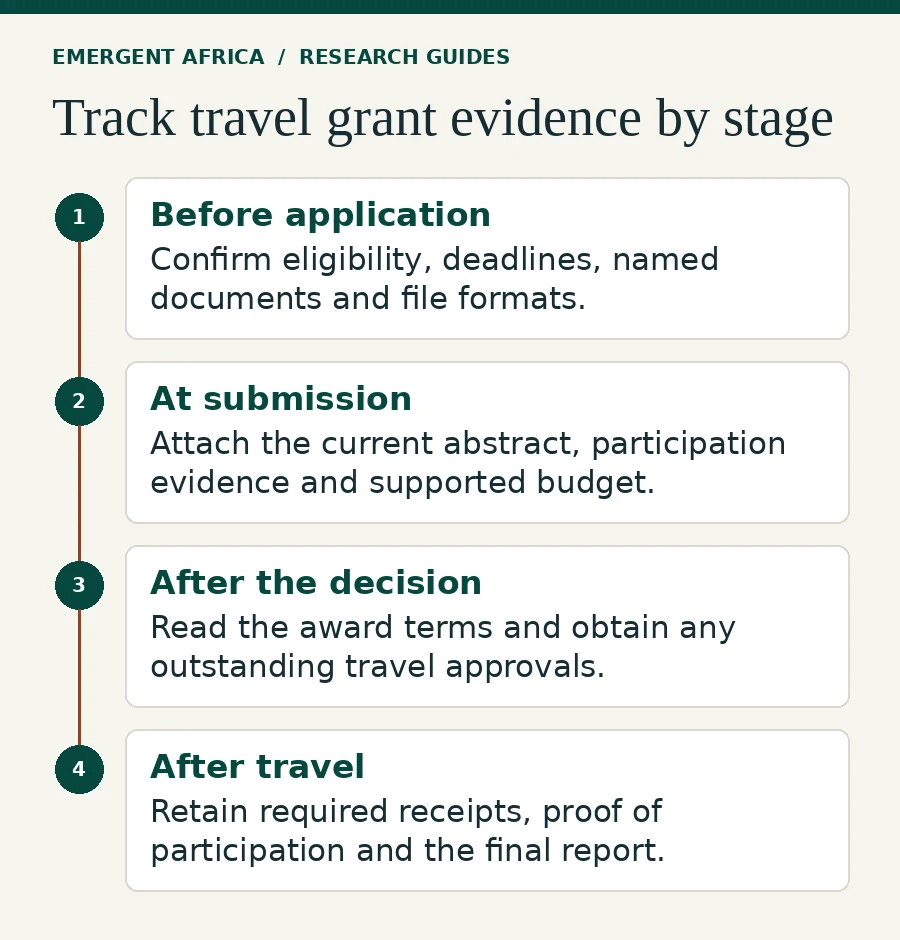
Before submitting, open each final file. Confirm readable pages, correct names and dates, clear scans and the required file size. Check any electronic signature, letterhead or direct reference upload requirement. Read the completed portal summary and compare the entered amount with the budget total. Save the application receipt and copy of the submission.
After an award decision, read the written conditions and record the eligible dates, acknowledgement requirements, reporting deadline and payment process. Confirm which costs the award will cover. Before booking, make sure any required travel or expenditure approval is in place. If the conference dates, location or attendance mode change, ask the funding office what documentation it needs.
After travel, collect the original receipts and proof of payment the scheme requests. Keep the final conference programme or participation confirmation, the final presentation details and any required report. Attach evidence for the costs claimed and note anything covered by another source. A receipt in one currency may need a conversion record if the claim uses another.
A filing example for one conference
Create a folder with a short name and year. Put the opportunity notice and reference instructions under “Call and rules”. Keep the submitted abstract, acknowledgement and acceptance together under “Conference evidence”. Put the current budget and quotes under “Budget”. Save the submitted package and receipt under “Submission”, then keep award terms and eligible expense evidence in “Award and claim”.
Within each folder, add a date or version to files that can change. If a travel quote expires, retain it as the basis of the original estimate and save the replacement separately. If the award administrator requests a revision, record the requested change and the date you sent it. Keep a clear record while following your institution’s retention and privacy requirements.
For an international conference, ask whether the funder accepts evidence in the organiser’s language or needs a translation. Preserve the original and label any translation clearly. Check that the translated document retains the official title, dates, amounts and presenter role. If a formal translation is required, plan for the turnaround time before the deadline.
Review whether a document contains information the funder does not need. A booking record may include unrelated travellers or details of a payment card. Follow the funder’s evidence and privacy instructions and use its approved submission route. When redaction is permitted, keep the original securely for your records and submit a legible copy with the information needed to assess the claim.
Frequently asked questions
Do I need conference acceptance before applying?
Check the exact call. Some schemes require acceptance, some accept a submitted abstract or allow evidence later, and some process claims after the event. Record your current status accurately and retain the organiser’s confirmation. Ask the funder about a pending decision before the deadline.
Should I submit both a quote and a receipt?
Use the documents required for the stage. A quote can support a prospective budget and a receipt can support a claim for an eligible expense. The funder may also require proof of payment or a booking invoice. Follow its instructions about estimates, booking dates and conversion rates.
Can I apply for more than one travel award?
Read each scheme’s rules on other funding and overlapping costs. Declare confirmed and pending support when required. Show which expenses each source would pay and update the funder if an award changes the request. Keep a reconciled record so the same expense is not claimed twice.
What if a required document is missing?
Identify who can provide it and ask the funder whether an alternative or later upload is permitted. Follow the written answer. If the funder requires the document at submission, plan around that requirement. Uploading an unrelated file makes the application harder to assess and may leave it incomplete.
What if I plan to present online?
Check whether the scheme covers virtual attendance or registration. The costs and evidence may differ from an in-person trip. Use the official programme and confirmation for the online presentation and ask whether the award requires a separate application route.
Browse research travel grant guides for budgets, supervisor letters and mobility plans. You can also review Emergent Africa membership grades and eligibility if you are looking for a professional research community.