

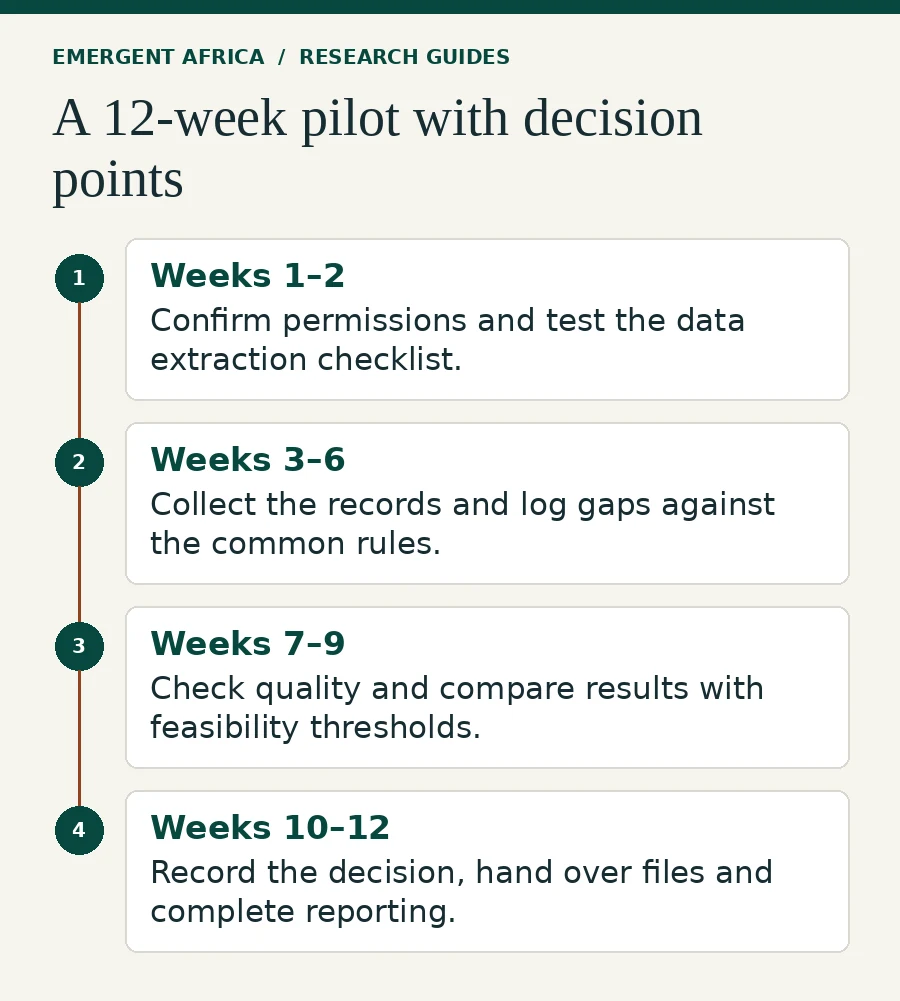
A pilot study grant timeline should show when permissions, preparation, data collection, quality checks and reporting will happen. Give each phase an owner and a measurable milestone. In the 12-week example below, the team checks data access by week two, finishes collection by week six, assesses feasibility in week nine and reports by week twelve.
The dates in a grant form have to agree with the work the team can deliver. If the plan says “collect data in month one”, the reviewer will ask whether access, training and the recording method are already in place. A timeline makes those dependencies visible. It should also show when you will decide to proceed, revise the plan or stop.

In this guide
Start with the feasibility decision
Write the decision first. For example, “At week nine we will decide whether the public records provide enough comparable coverage for a larger study.” That sentence gives the timeline a purpose. The preceding weeks now have to produce the evidence needed to make the decision.
Next identify the measurements, responsibilities and dependencies. A feasibility pilot may need a count of usable records, evidence that the procedure can be repeated or information about how long the work takes. For a participant study, appropriate feasibility measures might include recruitment, retention or completeness. Confirm the approvals and review process before collecting any data that requires them.
Avoid giving a short pilot an outcome it cannot support. A small data exercise can test whether a process works and show where a design needs revision. Claims about wider effects or representative findings need a suitable design and sample. The US National Center for Complementary and Integrative Health discusses this distinction in its guidance on intervention pilot studies. See NCCIH’s discussion of common uses and misuses of pilot studies.
A 12-week pilot study grant timeline example
Illustrative project: a team checks whether temperature and shade records can be matched across 30 locations in three neighbourhoods. The team already knows the public sources it plans to use. It must confirm reuse terms and test its extraction method before the full check. The budget and proposal are set out in the small research grant proposal example.
| Weeks | Work package and owner | Milestone | What must happen first |
|---|---|---|---|
| 1–2 | Project lead checks access and reuse terms. Assistant tests the extraction guide on five locations. | Source register and tested guide signed off by the lead. | Award start, confirmed responsibilities and access to the first records. |
| 3–4 | Assistant extracts the first two neighbourhood batches and logs incomplete fields. | First two batches entered with sources and a record of exceptions. | Approved guide and known rules for ambiguous fields. |
| 5–6 | Assistant finishes extraction. Lead resolves pending scope questions. | All 30 locations assessed or recorded as unavailable with a reason. | First batches reviewed and changes logged. |
| 7–8 | Second reviewer checks ten records independently. Team compares classifications. | Agreement summary and revised decision log. | Completed extraction and a documented selection for second review. |
| 9 | Project lead applies the feasibility thresholds. | Written decision to proceed, revise or seek an alternative source. | Coverage counts, review summary and list of unresolved gaps. |
| 10–11 | Team drafts the report, checks accessible outputs and confirms what can be shared. | Reviewed report, source inventory and reusable guide. | Decision recorded and permissions confirmed. |
| 12 | Project lead submits the report and the administrator reconciles costs. | Submitted report, receipt and organised project files. | Final review and budget records complete. |
An activity and a milestone are different. “Review records” describes work. “Ten independently checked records with disagreements logged” describes something the lead can verify. Include milestones where the team needs a decision, a transfer of work or evidence for the funder. A long list of routine tasks can obscure these points.
Define progression criteria before collecting data
The example’s lead needs enough complete records and enough agreement between reviewers to justify a larger study. Set thresholds before the outcome is known. Use a short note to explain why the threshold is appropriate for the next design. For instance, the team needs at least eight usable locations in each neighbourhood to maintain the coverage intended for the larger project.
| Feasibility check | Proceed condition in this example | Response if the condition is missed |
|---|---|---|
| Overall coverage | At least 24 of 30 locations have usable paired records. | Identify the missing fields and evaluate an alternative source. |
| Coverage across neighbourhoods | Each neighbourhood has at least eight usable locations. | Review the location selection or revise the scope of the larger study. |
| Repeatability of classification | At least eight of ten records receive the same initial classification. | Review disagreements, clarify the guide and repeat a defined subset. |
| Access and reuse | The team can use the necessary records and share permitted outputs. | Adjust the intended outputs or seek approval for a suitable substitute. |
These thresholds are planning choices for the fictional project. They are not methodological standards. When reviewing the results, consider how sensitive the decision is to a small number of records. If one disputed entry changes the conclusion, show that uncertainty in the report. Do not silently change the rule after seeing the data.
In a grant application, identify who makes the progression decision. In this example the lead reviews the counts and the second reviewer’s notes. The team records the reasoning and agreed next action in week nine. For a larger collaboration, specify when partners or an oversight group need to review the evidence.
Map dependencies and reserve time for decisions
Mark the work that cannot begin until something else has happened. Access confirmation is a dependency of extraction. A second review depends on complete records and the recorded guide. Reporting depends on a decision and permission to share the outputs. Build these relationships into the schedule rather than listing dates independently.
Some work can run in parallel. The administrator can check the expense process while the lead confirms access. The assistant can prepare a blank recording template before the sources are approved. If the project involves restricted material, only begin the affected work after the required access or approvals. Record the time needed for review and avoid assuming that all decisions will be immediate.
Plan a handover. If the second reviewer starts in week seven, they need the guide, sample selection and instructions for recording disagreements. The lead should make those files available before the review starts. A single sentence about the handover makes the schedule credible and gives the team an action to check in week six.
Show how a delay would change the plan
Consider a delay in the temperature data source. If access is unresolved at the end of week two, the team can use public example records to test the form while waiting. It should keep those tests separate from the final dataset. If access is still unavailable by the week four checkpoint, the lead evaluates the approved substitute or narrows the project with the funder’s agreement where required.
The team should protect the quality check and reporting period. Moving all extraction into weeks seven and eight may leave no time to resolve disagreements before the week nine decision. A stronger plan states which work can move, which work is essential and when an adjustment requires approval.
| Risk signal | Response | Person who decides |
|---|---|---|
| Source terms unresolved at the end of week 2 | Continue permitted template testing and ask the data owner for a decision date. | Project lead |
| A neighbourhood falls below the required coverage after first extraction | Trace missing fields and test the agreed alternative on a defined subset. | Project lead and assistant |
| Reviewer cannot complete the week 7 check | Use the agreed back-up reviewer if available and retain independent classification. | Project lead |
| Revised work would run beyond the award period | Check the terms and request any required approval before changing dates or costs. | Project lead and grants office |
A risk response should say how the revised work still answers the pilot question. “Allow extra time” is less useful than “move document formatting to week ten and use week eight to resolve mismatches.” Include the implication for scope, costs and the final milestone if the adjustment is material.
Connect the schedule to the budget
Review every budget line against the timetable. If the assistant’s 24 hours are funded over weeks two through eight, identify when their effort is needed and who supervises it. Put site checks or dataset purchases in the phase that uses them. Costing a task that does not appear in the timeline raises questions. Scheduling work with no time or budget assigned can be just as problematic.
For the example, the assistant might spend part of the first week of work testing the guide, use the main allocation for extraction and leave a small amount for checking records. The lead and second reviewer need their own time commitments confirmed. Identify in-kind support and avoid charging the same work to two sources. For cost reasoning, see the laboratory consumables budget justification guide.
Check the grant’s start and end dates and any different deadline for final reporting. A timetable with twelve weeks of project work can still need a separate reporting period under the award. Keep internal review and submission dates visible. Record whether spending, delivery and reporting must be completed by the same date.
Adapt the timeline to the form you must submit
Start with a table the project team can use. For each task, record the owner, start, end, prerequisite, output and decision trigger. If the application asks for a Gantt chart, map the same phases across the weeks or months. Keep the main milestones readable in the accompanying text so the reviewer can interpret the chart.
Use the funder’s wording for the approach, risk and resources fields. UKRI’s core application guidance asks applicants to explain how they will deliver their work and manage relevant risks. CIHR’s Project Grant review guidance also addresses the appropriateness of methods and the proposed contribution. These examples show why the schedule should support the assessment questions. See UKRI’s core application guidance and CIHR’s Project Grant review guidance.
For a shorter award, reduce the scope and confirm the dependencies that can be resolved before the funded period. For a longer award, show more detail around critical points. A six-month schedule might include partner approvals, a second pilot round and a longer review period. Match the level of detail to the decisions the reviewer and project team need to make.
Review the timeline before submission
Check the total project duration and start date against the eligibility rules. Ask a colleague to identify the first dependent task and the most important decision. Verify that each milestone has an owner and a document, record or output the team can check. Open the timeline in the format required by the funder and confirm the labels remain legible.
Have the project lead and finance contact read the same version. Confirm the timing of staff effort, access charges, travel and the reporting deadline. Save the submitted timeline and update the project team’s internal version when an approved change is made. A record of revisions helps everyone understand why dates moved.
Frequently asked questions
How many milestones should a pilot grant include?
Use enough to show the important checks and handovers. A short pilot may need a preparation check, data completion, a feasibility decision and reporting. Add milestones where a dependency, risk or partner decision makes it useful to verify progress.
Should the timeline include ethics or permissions?
Include the approvals relevant to the work, who is responsible and which tasks depend on them. Use the institution’s realistic review timeframe and check the funder’s rules about when approvals must be in place. Make room for revisions if the schedule depends on review.
What if the pilot misses its progression criteria?
Record the result and explain what it changes about the larger study. Consider whether a narrower scope, better procedure or different source would address the gap. Follow the award terms for changes and report any uncertainty that affects the recommendation.
Can I use a spreadsheet instead of a Gantt chart?
Use the format required by the call. A concise table can be enough when it clearly shows timing, milestones and dependencies. If the funder requires a chart, use the spreadsheet to reconcile tasks and dates before exporting it.
Explore research grant application guides for related eligibility and budget checks. If your research record supports an application for professional recognition, review the Emergent Africa fellowship criteria.
If a later, completed study leads to a peer-reviewed publication, you can check the Best Research Paper Award criteria to see whether the published work fits the award’s requirements.