

Put your final-year project under Research Experience or Selected Projects on a research assistant CV. Give it a descriptive title, your university and dates. Use two to four bullets to show what you personally did, which methods or tools you used and what you produced. Start with the bullet that best matches the vacancy.
A project title can show an interest in the subject. The bullets show whether you can carry out the work the team needs. A recruiter looking for careful data entry will learn more from a precise account of your checks than from a long description of your dissertation topic. Your experience can come from a dissertation, capstone, supervised placement or substantial course project.

In this guide
Decide where your project belongs
Place a strong project high on the first page when it is your clearest evidence for the post. If you have research employment, you can list it first and place the project below it. Use an accurate heading such as Academic Research Projects for course work. Include the qualification and institution separately under Education so the reader can understand the context.
For a short industry résumé or UK CV, give the relevant project a compact entry. An academic CV for a research group may call for more detail on presentations, publications and methods. Follow the vacancy’s file and length instructions first. Where the institution asks for a full academic CV, explain the project once and cross-reference outputs rather than repeating its description under several headings.
Keep role labels accurate. “Final-year dissertation researcher” can be appropriate when it clearly identifies a student project. “Research Assistant” suggests you held the role and should be used for a genuine appointment. A capstone completed with three classmates can still demonstrate strong research practice. State the scope of the team and the part you owned.
Map the job to evidence before writing
Read the description as a list of tasks. Pull out the verbs and expected outputs: extract, clean, label, code, check, schedule, summarise or document. Then identify which actions you have actually performed. Use your project notes, feedback, files and presentation to check the detail. Where your evidence is limited, describe the level of exposure accurately.
| Requirement in the vacancy | Evidence to look for in a final-year project | Example of a defensible CV bullet |
|---|---|---|
| Maintain a reliable dataset | Validation log, data dictionary or duplicate checks | Checked 180 municipal records against a data dictionary and logged missing location identifiers before analysis. |
| Use a named analysis tool | Your own script, spreadsheet or documented workbook | Used R to summarise temperature readings by site and kept a script that recreated the summary figures. |
| Follow a procedure | Versioned coding guide, checklist or practical notebook | Applied a supervised coding guide to a set of archival documents and recorded ambiguous cases for review. |
| Communicate results | Poster, slide deck, report or methods handover | Prepared a poster figure and explained the limits of the sample at the department’s student showcase. |
| Work with others | Task log, version history or agreed division of work | Coordinated weekly file handovers for a four-person capstone and maintained the shared change log. |
These are illustrative bullets. Use the task, scale and tools you can explain in an interview. A smaller accurately described dataset is stronger than an impressive number without a traceable source. If the employer requires a method you have only observed, keep the claim at the level of observation and identify evidence for related tasks you have performed.
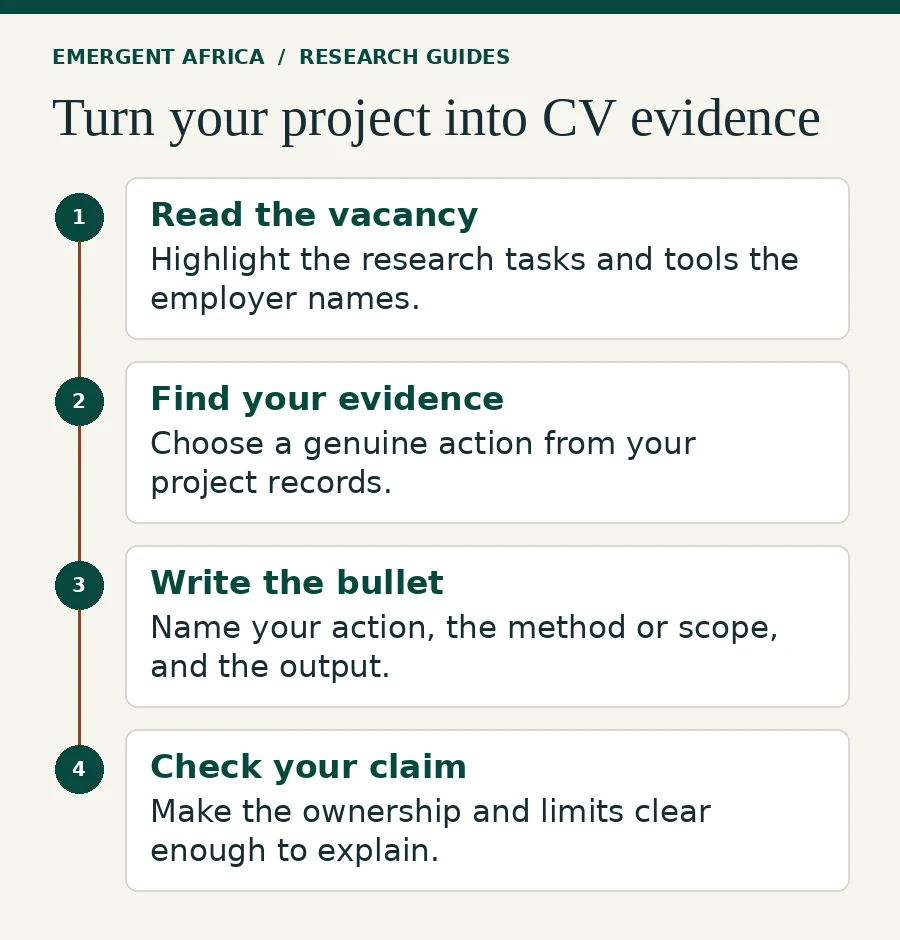
Write each bullet with action, context and output
Start with a verb that describes your own contribution. Add the material or method, then specify what the action produced. “Analysed research data” is too broad to help a hiring manager decide where you fit. “Cleaned 180 temperature records in R and produced a site-level summary for a dissertation report” gives the reader a useful picture of the work.
Use a number when it explains scale. Counts of records checked, files catalogued or sessions organised can help. A percentage improvement needs a baseline, a measurement method and a genuine comparison. When you cannot establish those, describe the output directly. It is fine to say that you identified duplicate entries or made a reproducible chart if those facts are supported.
For technical work, use the most relevant method name rather than listing every tool you touched. A vacancy asking for version control might be interested in your Git workflow. A role involving records may need a clear explanation of how you tracked exceptions. Combine tools only when they belong to the same task. Give the employer a reason to care about the software name.
A full CV project entry for a data role
Illustrative candidate: a geography graduate applying for a research assistant role involving public datasets, quality checks and concise reporting. The candidate has supervised project experience and no paid research appointment.
Final-year dissertation, Geography BSc | Example University | September 2025 to May 2026
Public temperature records and urban shade coverage
- Assembled 180 records from two public sources and documented the source, date, unit and site identifier for each field.
- Used R to flag duplicate records and missing identifiers, then logged the checks and kept a versioned copy of the analysis script.
- Summarised temperature observations by site and produced a coverage figure for the dissertation, with notes on locations missing comparable shade records.
- Presented the research question and limits of the dataset at a supervised departmental project session.
The entry gives the reader a question, independent actions and outputs. Its first two bullets could move in either order. If the role mainly asks for R, put the R bullet first. If the post focuses on cleaning and documenting incoming data, start with the assembled records and provenance. The dissertation title can stay the same while the emphasis changes.
The phrase “used R to flag” makes the action specific. It leaves space for a follow-up question about the checks. “Presented at a supervised departmental project session” distinguishes the output from a conference presentation or peer-reviewed paper. The university and dates make it clear that the entry describes academic experience.
Adapt the entry to other types of research
A group project involving interviews
Begin with the team context and name your contribution. A candidate might write: “In a four-person supervised project, coded six anonymised transcripts against the agreed coding guide and recorded interpretation questions for team review.” A second bullet could describe how they organised a codebook or produced a comparison matrix. Use a count only if your records support it.
If another member conducted the interviews, leave recruitment and interviewing out of your action verbs. You can still show that you managed notes, worked with structured documents and communicated uncertainty. Respect access conditions. Avoid adding participant details, raw transcripts or restricted links to a CV or portfolio.
A supervised laboratory project
Describe the task, training and records in terms relevant to the advertised laboratory. For instance: “Maintained the sample register and recorded instrument readings during supervised materials testing, following the course’s documented procedure.” A second bullet can identify a repeatability check or an equipment log you helped maintain.
Distinguish supervised performance from independent competency. A training session can establish familiarity with a tool. Repeated work using that tool can show practical experience within a defined scope. If the job requires certified competence, check whether the employer will accept academic training or expects separate documentation. Use the lab assistant application checklist to review that boundary.
A literature or archive project
Show your search decisions and how you organised evidence. A useful bullet might read: “Applied documented inclusion criteria to an initial set of 65 public reports and recorded reasons for exclusions in a screening sheet.” Another could describe the synthesis table or report you produced. Use the term systematic review only if the method and assignment support that description.
If the project found a gap or an unexpected inconsistency, describe how you documented it. A research team may need someone who can handle uncertainty carefully. A truthful bullet about reconciling classification decisions can be more relevant than an unsupported claim of original discovery.
Choose a CV format that fits the application
In the UK, the employer may request a CV and a separate supporting statement. Use the CV for a brief project record. Use the statement to answer the person specification with a more developed example. Our UK research assistant supporting statement guide shows how to turn the same evidence into a criterion-based narrative.
In the US and Canada, read whether the posting asks for a résumé, CV or standard application form. Some research groups request a CV with publications and presentations. A campus research job may ask for a résumé with the most relevant experience first. The University of Connecticut guide to undergraduate research CVs and résumés provides examples of describing goals, methods and contributions.
For European roles, use the language, format and documentation requested by the institution. A project title can be translated for clarity. Keep the official qualification name and describe the degree or programme where a foreign reader might need context. Use the Europass CV guidance when the employer accepts that format.
Check every claim before submitting
Read the first page without the rest of the CV. The employer should be able to identify your degree, project relevance and two or three concrete actions quickly. Remove course acronyms that only your department would recognise. Expand a specialist acronym on first use if it matters to understanding the work.
Open the final file and check that the text can be selected, the headings are readable and the project entry stays together. Give the file a clear name. Keep a copy of the vacancy and the submitted CV. Before an interview, make notes on the original task, your own contribution, one challenge and what you would do differently. Those notes help you give the same honest account orally.
Keep a private evidence log for yourself. For each CV bullet, note the project file or feedback that supports it, the name of a referee who knows the work and any permission that limits what you can share. This makes updating the CV easier when you add a later project. It also gives you a way to check dates and quantities without putting confidential material in the application.
If you contact a research group outside a formal hiring portal, name the relevant project skill in the email and keep the supporting detail in the CV. Check whether the group is accepting enquiries and follow its recruitment process. See the guide to emailing a principal investigator about research assistant work.
Frequently asked questions
Should I include my dissertation grade?
Include it if the vacancy requests it or if the grade adds context to a relevant project. Use the official result and grading scale where necessary. Your bullets still need to show the work you performed. A mark tells the reader about assessment, while your project entry explains the evidence they can assess for this job.
Can I include an unfinished final-year project?
Yes, if the project is relevant. Give the start date and label it in progress. Describe actions completed so far, such as drafting the collection guide or piloting the search. Identify planned work as planned. Update the entry when you have completed the analysis or submitted the report.
Should I attach the complete dissertation?
Follow the employer’s instructions. If a writing sample is requested, confirm whether it may be an extract and whether you have permission to share it. Remove information that must remain private or restricted. A short approved excerpt can help demonstrate methods and writing without creating an unnecessary attachment.
How many project bullets should I use?
Two to four well-chosen bullets often give a reader enough detail in a short application. Extend the entry if the employer asks for detailed methods or outputs. Make each bullet answer a different part of the role. Delete repeated claims that add no new evidence.
Find more research assistant career guides and compare the Emergent Africa membership grades and eligibility if you are looking for a professional research community.