

To apply for a first lab assistant job without paid lab experience, check the essential requirements, collect evidence from supervised practical work and tailor the documents the employer requests. Use your CV to list relevant tasks and the statement or cover letter to explain one or two examples. Confirm the file format, deadline and application route before submitting.
A useful lab assistant application checklist starts with the vacancy. Similar job titles can cover sample reception, stock control, teaching support, routine testing or records management. The same graduate may qualify for one post and need additional training for another. Spend your preparation time on roles where you can show the essentials.

In this guide
1. Check the type of laboratory and the essential criteria
Download the vacancy and person specification or save a copy. Record the laboratory type, location, hours, contract and closing time. Find the qualifications and experience described as essential. Write down any requirement for prior competency, a licence, registration, security clearance or language evidence exactly as the employer states it.
Read the duties as well as the job title. A teaching laboratory may value room preparation, inventory checks and support for students. An industrial laboratory may emphasise sample tracking, shift handovers or quality records. Clinical posts can have different qualification, training and regulatory requirements. Check the particular vacancy and the employer’s official guidance before describing your eligibility.
“Experience in a laboratory environment” may cover supervised academic work when the advert allows it. “One year of paid work in an accredited laboratory” is a different criterion. Where the wording is ambiguous, ask the named recruitment contact whether a project or placement would be considered. Quote the criterion and summarise your evidence in a sentence.
2. Build an evidence inventory from real work
List the practical tasks you completed, the procedures you followed and the records you produced. Include module work, a final-year project, a placement or an approved volunteering activity. Add transferable evidence where it relates to the role. A stock check in a shop can show how you notice discrepancies. It cannot establish that you are trained to handle particular laboratory materials.
| Vacancy requirement | Possible evidence for a first application | What to describe |
|---|---|---|
| Accurate records | Supervised practical notebook or stock spreadsheet | What you recorded, the check you performed and how you handled errors. |
| Follow instructions | Course procedure, checklist or competency record | Which parts you completed and the level of supervision. |
| Sample or materials tracking | Numbered practice samples, teaching inventory or project register | How you matched identifiers and reconciled inconsistencies. |
| Equipment preparation | Supervised setup or end-of-session checks | What you were trained to do and when you asked for help. |
| Teamwork and communication | Group practical, part-time work or shared handover | What you handed over and how another person could verify it. |
| Prioritisation | Several classes, tasks or orders with deadlines | How you identified priority, communicated a delay and completed the checks. |
Check your descriptions against the record. If you observed a method during a demonstration, say that you observed it. If you completed it several times under supervision, say so and name the task. You can use a precise claim about a simple procedure to show reliability. Add a named instrument or system only if you can explain your use of it.
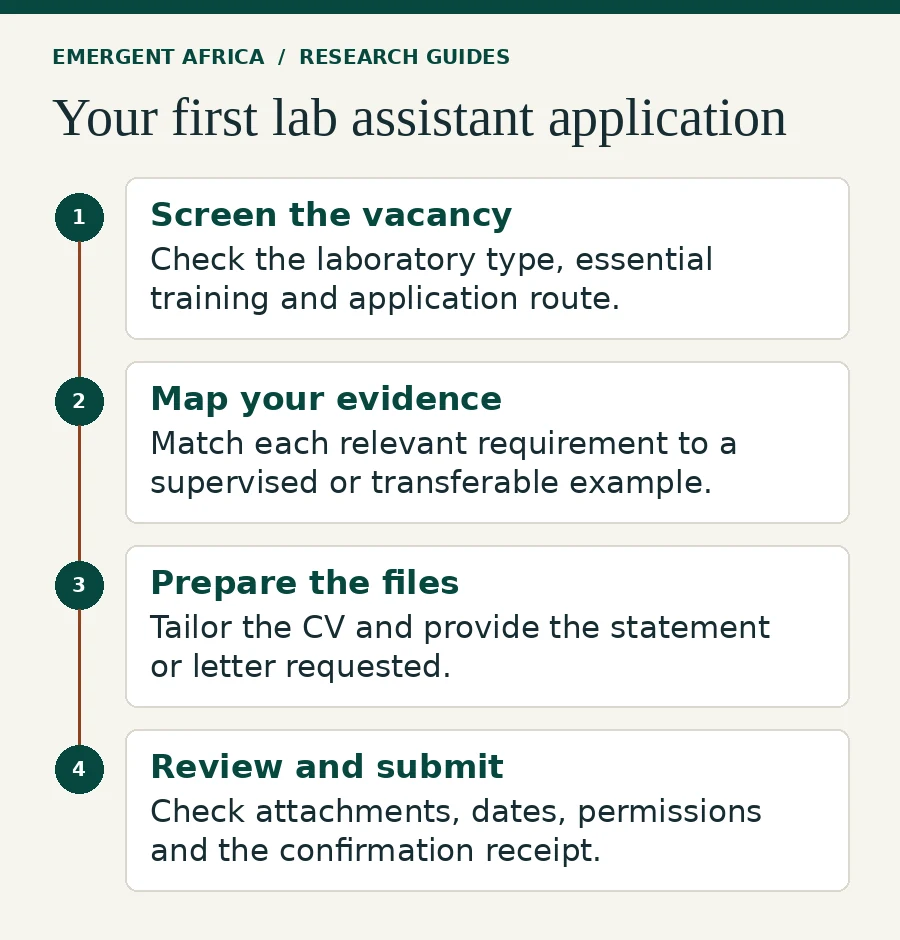
3. Tailor the CV or résumé to the work
Give the first page a clear structure. Include your name, contact details and the most relevant qualification and project experience. Add a short profile only if it helps the employer understand the fit. A strong opening could say, “Science graduate with supervised teaching laboratory experience, accurate inventory records and experience maintaining a shared project log.”
List tasks in the order the vacancy values them. If the role involves receiving and recording items, put evidence of identifier checks and careful records first. If it is a teaching support role, highlight preparation, safe working under instruction and communicating with the group. Keep a general CV for your own records and make a tailored copy for each application.
Use an action and an output in each bullet. “Maintained a shared materials list for a four-person practical group and flagged missing items before the next session” gives the employer evidence of a useful task. “Excellent attention to detail” does not show what you actually did. If your project is relevant, use the research assistant CV guide on final-year projects to organise the entry.
4. Prepare the supporting statement or cover letter requested
A supporting statement usually works best when it follows the employer’s criteria. Identify each essential requirement and use a short example that the reader can evaluate. A cover letter can explain your interest and select the most important evidence. If the portal asks for both, use the letter for the introduction and let the statement do the detailed matching.
Here is an illustrative response to a criterion about accurate record keeping: “During a supervised materials practical, our group used numbered samples and a shared register. I checked each identifier against the worksheet before recording its reading. When two labels appeared similar, I stopped the entry and asked the demonstrator to confirm the correct record. I logged the correction before we used the data in our report.” Replace the example with work you can describe.
If the advert identifies a skill you have yet to develop, check whether it is essential on appointment or taught after joining. Explain relevant preparation where the role allows training. Do not claim to have completed a competency assessment you have not taken. Use the UK laboratory assistant supporting statement guide and the lab assistant cover letter example for the appropriate format.
5. Assemble the document pack
Follow the portal rather than attaching every document you have. Save each required item in the correct format and with a clear filename. A PDF should open and contain selectable text unless the employer requests a different format. Read the instructions about whether to include names on anonymised application documents.
| Document | Prepare this | Before you upload |
|---|---|---|
| CV or résumé | A version tailored to the advertised tasks. | Check dates, contact details and the required file type. |
| Cover letter or statement | Specific examples matched to the employer’s instructions. | Confirm the word or character limit and correct role reference. |
| Qualification evidence | A transcript, certificate or training record if requested. | Use the requested document and authorised channel. |
| References | Referees who have agreed and can discuss relevant work. | Confirm roles, contact details and when the employer may contact them. |
| Work sample | A permitted excerpt only when asked. | Remove restricted or personal data and confirm permission. |
| Application form | Accurate eligibility and work history answers. | Reconcile the form with your CV and keep a submission record. |
A module tutor, supervisor or placement mentor may be able to comment on supervised work and reliability. Ask first and send the role description and the parts of the project they know. The employer may require a particular kind of referee. If you have worked outside science, a line manager can sometimes describe attendance, record keeping and handovers.
6. Check the market and employer’s terminology
UK. The National Careers Service lists lab assistant as an alternative title within its laboratory technician profile. The profile describes several routes into the occupation. Read the specific role’s qualifications and person specification, especially when a post is in a clinical or regulated setting. See the National Careers Service laboratory technician profile.
US. Search the institution’s job site for related titles such as laboratory assistant or technician. The Bureau of Labor Statistics describes biological technicians as supporting scientists with tasks including setup, data collection and observations. Its typical entry route is an occupational summary. The employer’s posting determines the degree and experience required for a specific job. See the BLS biological technician profile.
Canada. Read the employer’s description and any province-specific conditions for the role. Job Bank’s chemical laboratory technician profile gives an example of an occupation that covers technical support in several settings. The profile helps you understand the field while you check the actual posting for the qualification and training it requires. See Job Bank’s chemical laboratory technician description.
Europe. Check the country’s terminology, application language and credential requirements. Some employers request a local format, a CV in the advertised language or evidence of qualification equivalence. Use the official portal and send certificates or identity documents only as requested. See the Europass CV guidance if the employer accepts that format.
7. Do a final application check
Read the vacancy once more and tick each essential criterion you have addressed. Check that the names of qualifications, the institution and the dates match across documents. Confirm you have described the right laboratory and role. Update any generic sentence that could be sent to a different employer without changing a word.
Read the first half-page on a phone or narrow screen. Headings and bullets should still be easy to scan. Check the upload previews, including line breaks in text fields and any tables. Confirm the closing time and time zone, then allow time for the upload. Save the application reference and the version you sent.
Check that your contact details are current and that a referee can respond when contacted. If the employer gives an estimated recruitment timetable, note it with your application record so you can prepare for the next stage.
Prepare to discuss two examples if invited to interview. For each, record the task, your own action, the result or handover and what you learned. Expect to explain when you sought supervision and how you dealt with a mistake or inconsistency. Use the same evidence you gave in the application.
A worked decision for a new graduate
Consider a fictional graduate with a chemistry degree, supervised practical classes and part-time library work. One advert asks for a science qualification and accurate record keeping, with training on the employer’s inventory system. The graduate can show a practical notebook and experience checking library item identifiers. A tailored application is worth considering.
A second advert requires documented independent experience with a named system and a current professional credential. The same candidate may not meet those essentials. They can check the stated requirements with the employer, then direct their time towards a traineeship, assistant post or other entry route if the requirements are firm.
This comparison is more useful than applying to every vacancy containing “lab”. It identifies the gap the applicant can address through training and helps them use the right examples for roles they already fit. Keep a simple record of roles, requirements and responses so you can improve future applications based on evidence.
Frequently asked questions
Can I get a lab assistant job without paid experience?
Some entry roles consider relevant qualifications, supervised practical work or transferable skills. Check the stated essentials and training provisions for each vacancy. Use real examples and label the setting and supervision clearly. Look for trainee or entry-level routes when an advert requires experience you do not yet have.
Should I list all the equipment I used at university?
List the equipment or procedures relevant to the job and describe what you did. Explain whether you observed, assisted or used it under supervision. Leave unrelated equipment off a short CV. Keep a fuller training record for your own reference or for applications that specifically ask for it.
What if the advert does not ask for a cover letter?
Follow the instructions. Use the CV or application fields to show relevant evidence and attach a letter only where the process allows it and it adds value. If there is a supporting statement field, give it the detail the panel needs to assess the essential criteria.
How can I show safe working without claiming independent competence?
Describe the instructions, supervision and checks you followed during the task. A useful example explains how you kept records, checked a label or asked for help when something was unclear. Identify any training certificate accurately and follow the new employer’s induction and competency procedures.
Browse more laboratory assistant career guides for CVs, letters and supporting statements. If you want to take part in a professional research community, compare the Emergent Africa membership grades and their published eligibility requirements.