

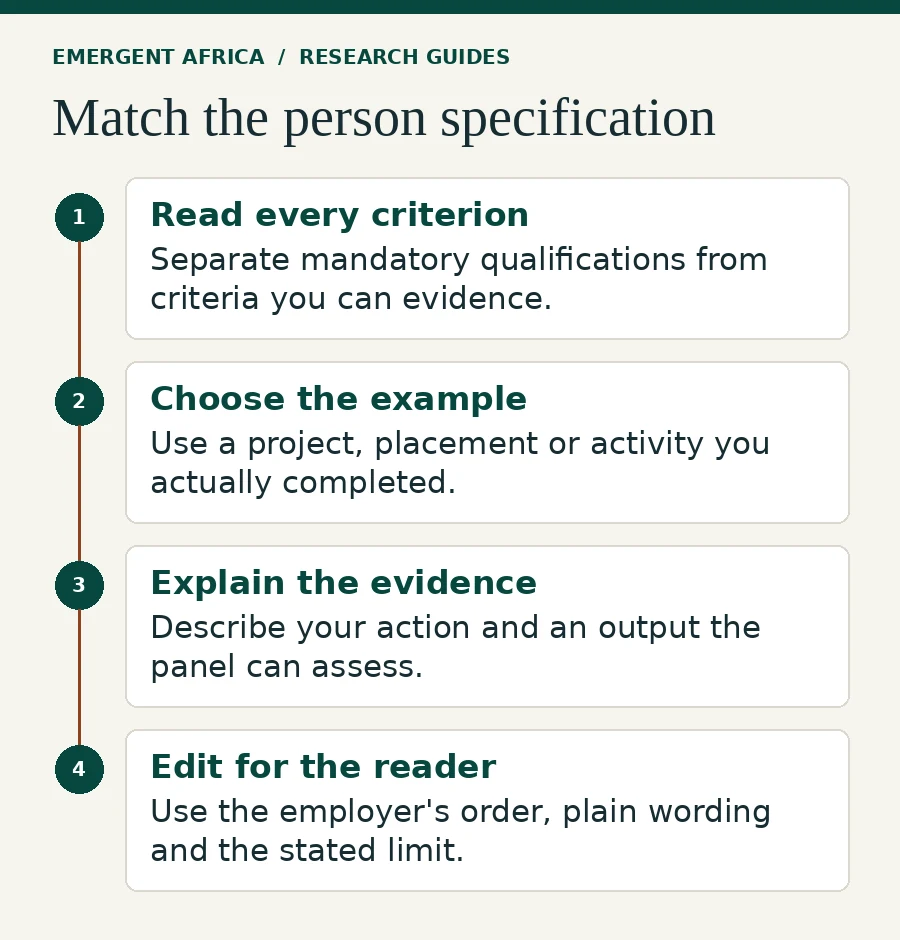
Write a UK research assistant supporting statement by answering the person specification in order. Give one verifiable example for each essential criterion, using your dissertation, coursework, placement or other relevant experience. Explain your own action, the method you used and the output. Use the employer’s limit and say where your experience was supervised.
You can write a credible statement without having held a paid research job. The strongest examples show the panel that you can do the tasks the post needs. An academic project can demonstrate data checking, document review and communication. A part-time role can show reliability and handovers. The vacancy determines whether those examples meet its requirements.

In this guide
Read the person specification before drafting
Save the job description and locate the essential and desirable criteria. Separate qualifications, experience, knowledge and practical requirements. Check whether a criterion must be met on appointment or is part of training after joining. Where an advert requires a particular degree, method or documented certification, confirm whether you meet it before spending time on the rest.
Use the tasks in the job description to interpret broad criteria. “Organisational skills” could mean maintaining participant appointments in one project and cataloguing source records in another. “Communication” could mean explaining an analysis to a colleague, writing a short methods note or working with external partners. Choose evidence that matches the tasks described.
Oxford’s recruitment guidance asks candidates to show how they meet the selection criteria and recognises examples from education and other experience. Cambridge’s applicant guidance also asks for specific evidence in suitability statements. Read the instructions for the vacancy you are applying to. See Oxford’s application guidance and Cambridge’s applicant guidance.
Create an evidence map for the role
Copy the criteria into a worksheet in the advertised order. For each one, record a real task, your contribution, the material or method and a verifiable output. If a criterion covers several skills, identify which parts the example actually demonstrates. Add a second brief example when one does not cover the full requirement.
| Example criterion | Candidate evidence | What the statement should demonstrate |
|---|---|---|
| Relevant degree or equivalent | BSc with a final-year project on public transport access. | Name the qualification and connect the project to the role. |
| Collect and check data carefully | Extracted 120 entries from published timetable records using a documented guide. | Explain what was checked and what happened when records conflicted. |
| Use spreadsheets to organise information | Built a tracker with identifiers, source dates and status flags. | Show how the team could trace and review the entries. |
| Communicate findings clearly | Presented a map and a short methods note in a student project session. | Explain how you made a limitation understandable. |
| Work reliably as part of a team | Maintained a weekly task record for a supervised group project. | Specify the handover and how it helped others continue. |
The criteria and numbers in this example are fictional. Use evidence you can explain and corroborate. If your best example is a group project, mention the group and then describe your part. “We produced a report” establishes the shared outcome. The next sentence should tell the reader what you did to help produce it.
Turn the evidence into short paragraphs
Start each paragraph with the relevant criterion, unless the form already provides it as a heading. Use a simple structure. Give the context, describe the task, explain your action and state the result or deliverable. Spend most of the space on the action because that shows the panel how you work. Name the method when it helps the reader judge relevance.
For an accuracy criterion, a useful paragraph might begin: “In a supervised dissertation, I extracted information from published transport records using a guide agreed with my supervisor.” Follow with the checks you performed. For example, “I compared route identifiers and source dates, flagged incomplete records and recorded why entries were excluded.” Close with the result, such as a documented table the supervisor could review.
Keep achievements proportionate. A completed quality check can be a valid result. So can an error log, a handover or a presentation that helped the team understand a limitation. Use a number if it adds information and you can verify it. Avoid promising a result you cannot control or using success claims that the underlying evidence does not establish.
An example supporting statement for a UK research assistant role
Illustrative role and applicant: a recent geography graduate applying to a university team that extracts public records, checks data quality and prepares short summaries. The role accepts a relevant first degree and evidence from academic projects. Adapt the structure to the actual person specification.
Relevant qualification and interest. I completed a BSc in Geography at Example University. My final-year dissertation examined differences in weekend bus timetables and access to public facilities. I am applying because the post involves turning records from several public sources into reliable evidence for a wider research team. My project gave me supervised practice in recording the origin of data and explaining its limitations.
Data collection and accuracy. I extracted 120 timetable entries using an agreed recording guide. I recorded the route identifier, publication date and source for each entry. When two sources used different names for the same route, I marked the record for review and checked the agreed matching rule with my supervisor. I kept a log of the decisions and rechecked entries affected by a changed rule. The log allowed my supervisor to trace how I reached the final dataset.
Organisation and digital skills. I used a spreadsheet to maintain the source register and mark each entry as checked, incomplete or awaiting clarification. I applied a duplicate check before analysis and separated the raw records from the cleaned table. I used a short file naming guide to make the latest version easy to identify. I would use the team’s procedures and ask for training on its own research systems.
Communication and teamwork. At a supervised student project session, I presented a map and explained why incomplete records affected comparison between neighbourhoods. I prepared a short methods note that described the missing data and the limits of the finding. In a separate group project, I maintained the shared task record and summarised outstanding decisions before each handover. The group used that record to assign the next week’s work.
Availability and approach. I can work the hours stated in the advert. I would bring experience of careful source documentation, a willingness to learn the team’s workflow and a habit of recording questions early when information is unclear. I can provide an approved extract of my methods note if a writing sample is requested.
The first paragraph explains motivation using the work of the post. The data paragraph shows how the graduate handled a concrete problem. The digital paragraph avoids claiming familiarity with the employer’s system. The communication example describes what the applicant explained and why it mattered. Each paragraph gives the panel something it can assess.
The last paragraph is optional. Use it only when the application asks about availability or other practical matters. If the vacancy asks for a writing sample at submission, supply the specified file. If it does not, keep the statement focused on the requested evidence.
Handle experience gaps directly
Check the wording of the gap. If the role asks for experience handling research data and you have done that in a dissertation, describe the supervised setting. If it requires a method you have not used, identify the related task you can evidence and the training you would need. If the criterion explicitly requires prior independent competency, a related example may be insufficient. Confirm the position with the recruitment contact if the advert allows it.
You can write, “I have used spreadsheets to validate and document project records. I have not yet worked with the named database. During my dissertation I learnt a new data structure using written guidance and checked my outputs with my supervisor.” That gives the panel a truthful basis for judging transferable skills. Avoid vague promises that every gap can be resolved quickly.
Some research posts require specialised experience or a higher degree. The title research assistant alone does not tell you whether a role suits a new graduate. For example, different Cambridge job specifications identify different degree and methods requirements. Check the person specification for the role you are considering and keep the example tied to it.
Keep the statement distinct from the CV
Your CV lists education, dates, projects and outputs. The supporting statement interprets those facts against the criteria. A short project entry could say that you maintained a source register. The statement can explain which fields you recorded, how you handled ambiguous identifiers and why the log helped your supervisor.
Use the same numbers and dates across both files. If your CV says 120 extracted entries and your statement says 115, explain the difference between the initial and cleaned sets if both numbers matter. Check that your role and level of supervision are consistent. For help structuring the project entry, see how to present a final-year project on a research assistant CV.
Avoid repeating a full project description under each criterion. Reuse a project where it supplies different actions, such as data extraction for one paragraph and reporting for another. If the evidence is stronger elsewhere, use a second example. A brief choice of examples can help the panel see the range of relevant work you have done.
Edit the statement for shortlisting
Read the criteria beside the statement. Highlight where each essential item is addressed. If a paragraph could fit any vacancy without changes, connect it to a task in this role. Use plain explanations of methods and expand unfamiliar acronyms. Keep quotations or extended background out unless they demonstrate the specific requirement.
Check the word or character limit and use the format the portal requests. If the form uses separate fields, distribute the answers as directed. If it asks for a single document, headings can make it easier to follow the specification. Confirm any anonymisation rules, attachment names and reference number. Open the final file before submitting and keep the application record.
Ask a colleague to read one evidence paragraph and tell you what they would ask about at interview. They should be able to identify your action and the result without guessing. Prepare to explain how you made a decision, what you learnt and what you would improve. The strongest interview preparation is the work you can already describe accurately.
Make a final check for repeated opening phrases. Give each paragraph a clear subject, such as the quality check you carried out or the handover you prepared. This helps a panel locate the evidence when it reads several applications in sequence.
Frequently asked questions
Can I use a dissertation if I have no paid research experience?
Yes, where the employer accepts academic or equivalent experience. State the context and show relevant actions such as using a documented method, checking data or producing a report. Read the exact wording for requirements that specify paid work, a credential or independent experience.
Should I answer desirable criteria as well?
Address essential criteria first. Add evidence for desirable criteria you meet, especially when they relate closely to the post. If space is limited, focus on evidence that helps the panel compare candidates. Do not imply that you meet a desirable criterion if you have only observed the task.
Is a supporting statement a personal statement?
Use the employer’s wording. In many UK recruitment forms, the supporting statement is the evidence of suitability against a person specification. A brief reason for applying is useful, but most of the space should show how you meet the listed requirements.
How long should my statement be?
Follow the limit in the advert or form. Where the employer provides no limit, give enough detail to address each relevant criterion and keep paragraphs easy to scan. Remove repeated descriptions of the same task and keep the strongest evidence.
Find more research assistant career guides or learn how to contact a principal investigator about a research assistant role. For laboratory vacancies with their own person specification, read the laboratory assistant supporting statement guide. You can also compare Emergent Africa’s membership grades and the published criteria for each.